← Britannica Capital · Research & Intelligence
Chokepoint Analysis

Physical Constraints Define Value

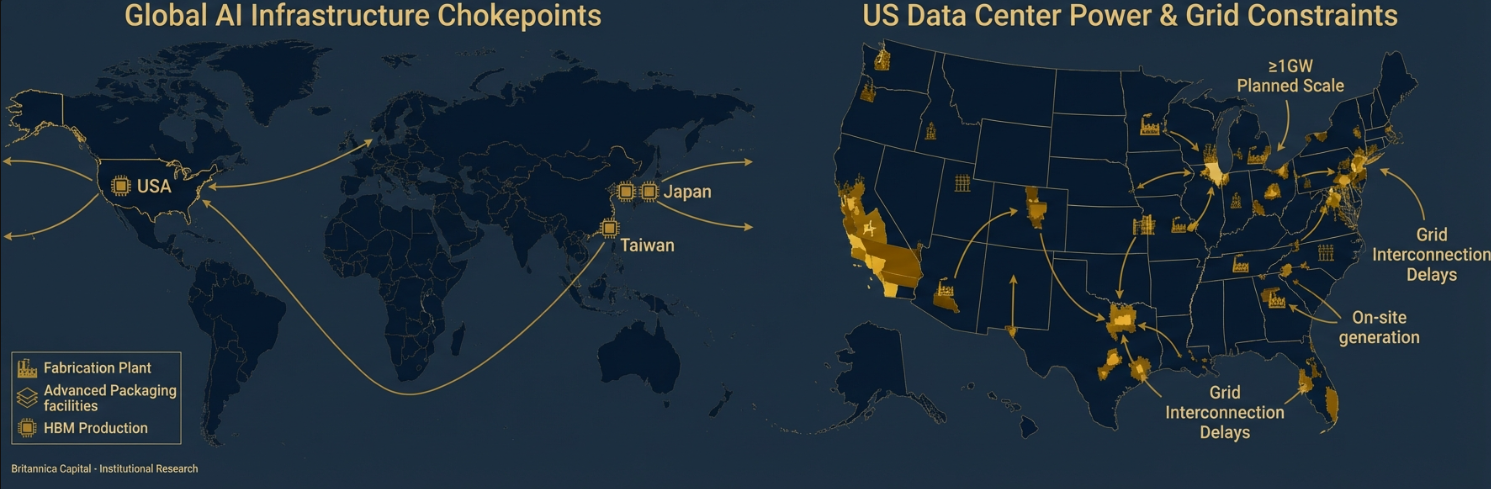
AI infrastructure confronts constraints that software innovation cannot circumvent. Grid capacity, interconnection timelines, thermal management, and long-lead electrical equipment form the binding constraints shaping investment returns.

Supply Chain

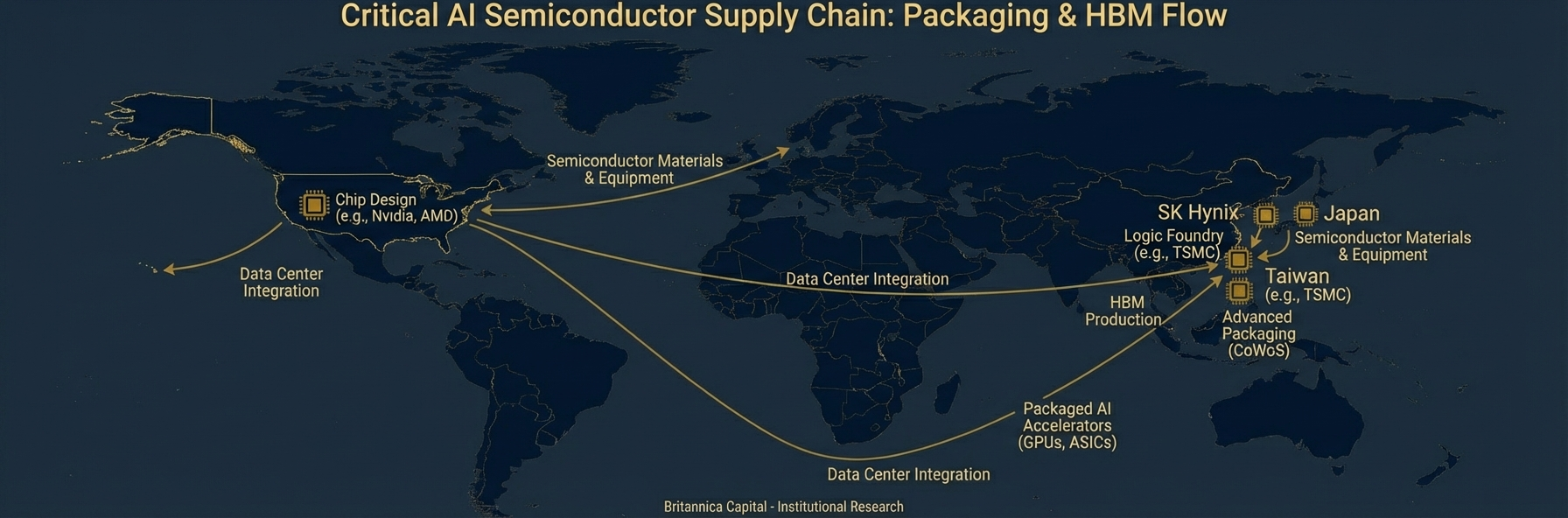
Packaging & HBM as Strategic Inputs

The bottleneck has migrated beyond leading-edge fabrication into advanced packaging and high-bandwidth memory. TSMC has described advanced packaging as a rising share of its revenue and, at its July 2026 results, characterised packaging capacity as tight enough to limit customer growth. SK hynix reported the start of HBM4 mass shipments in the second quarter of 2026, per its 2Q26 results release.

Power Infrastructure

Grid Edge as Investment Variable

The IEA projects that data centers will account for nearly half of US electricity demand growth through 2030 (Energy and AI, April 2025). Gigawatt-scale campuses have moved from plan to construction in 2026, and the largest announced single-site designs have grown to multi-gigawatt scale, per company announcements—load comparable to several nuclear reactors.

Investment Framework

Durability vs Cyclicality

When hyperscaler capex moderates, what prevents margin compression? The four largest hyperscalers raised capital-expenditure guidance again at their mid-2026 results, per company earnings releases, but the question stands. Durable winners possess chokepoint scarcity, standards depth, and multi-year lead times. Cyclical beneficiaries reflect temporary supply tightness.

Video Content
Video briefings and infrastructure analysis walkthroughs will be available here. Content is currently in production and will be published upon completion.
Executive Summary

Artificial intelligence has evolved from a software narrative into an infrastructure regime constrained by physical realities: grid capacity, interconnection timelines, thermal management, and long-lead electrical equipment. The critical distinction for investors lies not in identifying AI exposure broadly, but in separating durable competitive positions from cyclical beneficiaries of hyperscaler capital expenditure.


Structural rents accrue to chokepoints—nodes where capacity is genuinely scarce and replication requires years rather than quarters. The bottleneck has migrated beyond leading-edge semiconductor fabrication into advanced packaging and high-bandwidth memory, fundamentally reshaping value capture across the stack.


The fundamental question remains straightforward: when hyperscaler capital expenditure moderates, what prevents margin compression? If the answer centers on temporary supply tightness, the position is likely cyclical. If the answer involves standards depth, qualification barriers, and multi-year lead times, durability becomes more defensible.

~50%
Share of US Electricity Growth
Per IEA · Energy & AI (Apr 2025), data centers to 2030
≥1GW
Campus Scale Under Construction
Multiple US sites · Per company announcements
CoWoS
Packaging Capacity Constrained
TSMC · 2Q26 results call (Jul 2026)
HBM4
In Mass Shipment
SK hynix · 2Q26 results release (Jul 2026)
01
From Software to Infrastructure

The Physical
Constraint

When investors discuss artificial intelligence, conversations reflexively center on models—benchmark performance, conversational interfaces, and product demonstrations. Yet market exposure increasingly resides in less conspicuous territory: the physical bottlenecks transforming intelligence into electricity consumption, semiconductor wafers, data center racks, network fabric, and heat rejection systems.

Artificial intelligence has become fundamentally an infrastructure proposition because it confronts constraints that software innovation cannot circumvent. The International Energy Agency projects, in its Energy and AI report (April 2025), that United States data center power consumption will account for nearly half of electricity demand growth through 2030; by that horizon, per the same IEA analysis, the American economy is expected to consume more electricity processing data than manufacturing energy-intensive goods. The IEA's 2026 follow-up work indicates the trajectory is being met, with global data center electricity demand continuing to grow rapidly in 2025 and AI-focused facilities growing faster still.

The gigawatt threshold, flagged in earlier reporting as a 2026 milestone, has now been crossed in practice. Per company announcements, campuses designed at one gigawatt or more are under construction across several US states, the largest announced single-site designs were expanded to multi-gigawatt scale during 2026, and the largest multi-site programmes have first phases operating with further multi-gigawatt build-out planned through the end of the decade—load comparable to multiple nuclear reactors.

Force 1

Physical Bottlenecks

Power, silicon, packaging, memory, and networks function as genuine chokepoints, constraining supply, shaping margins, and rendering time-to-capacity the decisive competitive weapon.

Force 2

Ecosystem Lock-In

Software standards, developer toolchains, and reference architectures embed switching costs, enabling select suppliers to extract platform-like economic rents.

Force 3

Policy Architecture

Export controls, industrial subsidies, and sustainability mandates increasingly dictate who can build capacity, where, and with which components.

Feedback Loop

These forces collectively form a mechanism: bottlenecks accelerate capital expenditure; concentrated spending strengthens ecosystems; policy redirects supply chains. Together, they elevate capacity planning into a macroeconomic variable.

02
The Value Chain Architecture

Five Distinct
Economic Layers

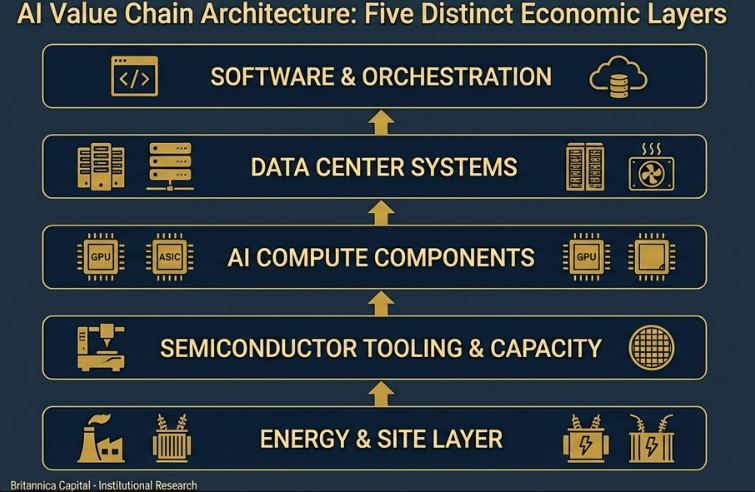
A disciplined approach to "AI trades" requires abandoning monolithic framing. AI infrastructure represents a layered system with distinct economic characteristics. The analytical error involves assuming uniform durability across this stack. Identical spending waves simultaneously create durable winners and cyclical beneficiaries.

1
Energy & Site Layer — Generation capacity, grid interconnection, transformers/switchgear, land, permitting, water, thermal rejection. The IEA tracks planned capacity at risk from grid delays.
2
Semiconductor Tooling & Capacity — Lithography and process equipment; leading-edge wafer fabrication. Capability concentration visible in equipment manufacturer reporting.
3
AI Compute Components — Accelerators (GPUs, ASICs), high-bandwidth memory, substrates, advanced packaging—the integration layer enabling high-performance systems at scale.
4
Data Center Systems — Servers, NICs/DPUs, switching infrastructure, storage; plus power delivery and cooling systems.
5
Software & Orchestration — Compilers, toolchains, libraries, scheduling, cloud control planes—where standards establish defensible moats.
03
Power and Place

Strategic Leverage at
the Grid Edge

At the grid boundary, global economic activity exhibits a measurable pulse—and artificial intelligence is beginning to materially influence that rhythm.

The International Energy Agency's assessment proves unambiguous: per its Energy and AI report (April 2025), US data center power consumption is projected to drive nearly half of demand growth through 2030. The constraint is now tangible: per company announcements, multiple American campuses with ≥1GW design capacity are under construction, and single-site design targets have climbed to multi-gigawatt scale.

When grid timelines diverge from hyperscaler deployment schedules, developers circumvent bottlenecks. Third-party industry tracking (Cleanview, mid-2026) identifies a large pipeline of behind-the-meter generation planned for US data centers—predominantly natural gas, including aeroderivative turbines adapted from aviation engines, reciprocating engines and mobile units—of which only a small fraction is operating, with a modest further tranche expected online by year-end 2026. The equipment itself is now a bottleneck: GE Vernova reported a gas-turbine equipment backlog of 116GW, against annual output of roughly 20GW, in its second-quarter 2026 results release (22 July 2026).

Cost-allocation disputes between utilities, states and technology companies have moved from anecdote to market structure. PJM's Base Residual Auction for the 2028/29 delivery year procured 138,318 MW of capacity, per PJM's 14 July 2026 results release; the independent market monitor (Monitoring Analytics) attributed a substantial share of the resulting capacity charges to data center load. PJM has since filed for a one-off reliability backstop procurement in autumn 2026 to address a shortfall against its reliability requirement, while individual states are deciding which large loads should bear the cost.

The Durability Separator

Durability in the power layer accrues to regulated infrastructure bottlenecks, scarce long-lead electrical equipment, and enabling infrastructure where capacity expansion cannot be accelerated arbitrarily.

Cyclicality characterizes commoditized construction, fit-out services, and components subject to aggressive re-bidding once deployment velocity moderates.

"Not every infrastructure supplier possesses sustainable competitive advantages. Economic moats belong to controllers of the narrowest, most difficult-to-bypass constraints."
Britannica Capital Research
04
Historical Precedent

From Mainframes to
Hyperscalers

Artificial intelligence appears novel, yet its durable economics reflect established patterns: winners frequently transform early technical decisions into industry standards, subsequently compounding advantages through ecosystem gravitational effects.

This dynamic manifests most clearly in compute platforms. Nvidia's SEC filings characterize its competitive position not as semiconductor products alone, but as a comprehensive computing platform supported by extensive software infrastructure—CUDA, CUDA-X libraries, APIs, SDKs, and domain-specific frameworks.

Regardless of which model architectures ultimately dominate, the principle remains constant: interfaces and developer standards outlast individual product generations.

Comparable path dependence exists deeper in the supply chain. Semiconductor tooling and leading-edge manufacturing represent not capacity deployed within annual cycles, but institutional capabilities developed across decades. ASML's annual reporting reflects the centrality of its lithography systems to producing progressively advanced semiconductors.

What Proves Difficult to Replicate
  • Learning curves — Yield optimization, reliability, thermal design, power delivery
  • Ecosystems — Toolchains, libraries, developer mindshare
  • Scale procurement — Priority allocation during supply constraints
  • Time-to-capacity — Fabrication facilities, packaging lines, grid infrastructure

These constitute durability ingredients. Market enthusiasm does not.

05
Internal Structural Tensions

Bottlenecks &
Fractures

AI infrastructure exhibits characteristic fractures: concentration risk, migrating bottlenecks, and reflexive capital expenditure dynamics. The scale of the spending has only increased: at their mid-2026 results, Amazon, Alphabet, Meta and Microsoft each raised capital-expenditure guidance again, per company earnings releases and calls, with each citing demand in excess of available capacity and some citing higher memory costs. Understanding these tensions separates durable from transitory advantages.

Critical

Packaging & Memory Chokepoint

This cycle established a fundamental lesson: leading-edge wafer fabrication no longer represents the sole constraint. TSMC has described advanced packaging as a rising share of its revenue and, at its July 2026 results call, characterised CoWoS capacity as fully committed through year-end; third-party estimates (TrendForce, June 2026) suggest the CoWoS supply gap narrows through 2026 as capacity expands. SK hynix reported the start of HBM4 mass shipments and a record operating margin in its 2Q26 results release; TrendForce estimates put HBM4 at a substantial per-gigabyte price premium to HBM3E, and Nvidia flagged memory scarcity as a margin pressure in its second-quarter fiscal 2027 release (August 2026)—memory has moved decisively from commodity to strategic input.

Structural

Capex Reflexivity

When limited purchasers fund majority capacity, cycles extend longer because balance sheets are strong—but purchasers eventually leverage concentration as bargaining power on pricing, roadmaps, and second-sourcing. Benefits genuine chokepoints; pressures "adequate" suppliers.

Counter-Force

The Efficiency Pressure

Every infrastructure expansion confronts efficiency improvement: enhanced utilization, improved inference efficiency, architectural innovation. When efficiency gains materialize, margins lacking lock-in effects face mean reversion first.

Subtle Durability

Packaging and HBM can represent current bottlenecks, yet bottlenecks migrate. If capacity additions overshoot demand, pricing normalizes rapidly. Durable advantages reside not in "tight supply" itself, but in what remains difficult to replicate when supply loosens: process leadership, yield discipline, integration expertise, and qualification depth.

06
Export Controls & Industrial Policy

The New Regulatory
Architecture

In geopolitically-conscious investing, sanctions never constitute footnotes—they define market structure. In AI infrastructure, export controls and industrial policy increasingly perform this function.

In January 2025, the US Commerce Department's Bureau of Industry and Security published an interim final rule revising controls on advanced computing integrated circuits and introducing controls on certain AI model weights. Policy subsequently evolved: BIS rescinded the "AI Diffusion Rule" in May 2025 and, per its 13 January 2026 press release, revised its licence review policy to permit case-by-case approval of H200-class and comparable accelerators for approved Chinese customers, conditional on no reduction in supply to US customers, buyer compliance programmes and independent US testing. In June 2026, according to press reporting, BIS further clarified that licence requirements apply to China-headquartered firms wherever they operate.

The policy loosening has not, to date, translated into reported sales: Nvidia's August 2026 outlook assumes no data center compute revenue from China, per its second-quarter fiscal 2027 release. The investment implication transcends bureaucratic detail—the compliance envelope is shifting on both sides of the Pacific, with supply chains reorganizing accordingly.

Policy as Market Structure

Industrial subsidies reshape capacity geography. US Department of Commerce CHIPS Act awards to TSMC Arizona were explicitly tied to establishing leading-edge manufacturing clusters domestically. TSMC has continued to expand the scope of its Arizona plans, including advanced packaging, per its 2026 results commentary.

Europe pursues parallel objectives. The European Commission has put forward a Chips Act 2.0 proposal in 2026 intended to extend state-aid scope across the value chain, including advanced packaging, and to add demand-side measures; it remains in the legislative process.

Sustainability becomes regulatory. The recast Energy Efficiency Directive (Directive (EU) 2023/1791) introduced monitoring and reporting obligations for data center energy performance, supported by an EU-level database.

"Policy doesn't merely adjust addressable markets. It determines permissible supplier relationships—and what 'deliverable capacity' actually means."
Britannica Capital Research
07
The Fundamental Distinction

Durable Winners vs
Cycle-Driven Beneficiaries

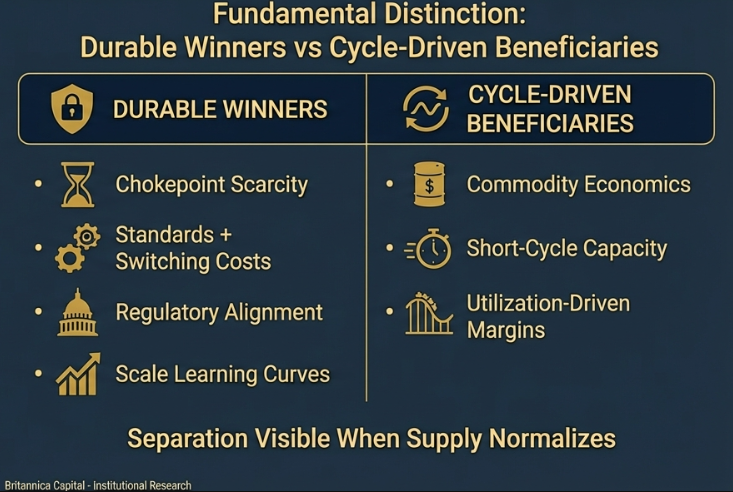
The most effective discriminator reduces to a single question: When supply normalizes—or hyperscaler capital expenditure moderates—what prevents margin compression?

Durable Winners

Typically possess at least two of:

  • Chokepoint scarcity with multi-year lead times (years, not quarters)
  • Standards + switching costs (toolchains, embedded architectures)
  • Regulatory/geopolitical alignment (subsidized/onshored capacity; compliance advantages)
  • Scale learning curves (yield, reliability, total cost of ownership)
Cycle-Driven Beneficiaries

Typically exhibit:

  • Commodity economics (price-taking; facile substitution)
  • Short-cycle capacity (supply scales rapidly)
  • Utilization-driven margins (booms masquerade as moats until normalization)
Why AI Cycles Prove Hazardous

During build-phase acceleration, every participant appears positioned for success. Differentiation emerges only when constraints migrate, procurement discipline intensifies, and policy redirects capital flows. The separation becomes visible when supply catches up.

08
Conclusion

A Persistent Market
Variable

"AI infrastructure is becoming central to market risk for the identical reason geopolitics and chokepoints always matter: where scarcity proves genuine and time horizons extend, pricing power concentrates."
Britannica Capital Research — September 2026

The opportunity is substantial but non-uniform. Grid capacity remains constrained, supply chains remain concentrated, and the regulatory regime remains fluid. The infrastructure build-out will likely reward owners of bottlenecks, standards, and long-lead capacity—while periodically punishing those whose earnings simply reflect hyperscaler capital expenditure.

That represents the fundamental separation: durable winners are defined by what remains indispensable when cycles turn.

Investment Framework

The grid remains constrained. The supply chain remains concentrated. The controls regime remains fluid. In this environment, capacity planning has become a macroeconomic variable, and the distinction between structural moats and cyclical windfalls has never mattered more.

Sources & Data Notes — As of September 1, 2026
  • International Energy Agency — Energy and AI (April 2025) and Key Questions on Energy and AI (2026); Electricity 2026 (February 2026).
  • NVIDIA — Second Quarter Fiscal 2027 results (26 August 2026). SK hynix — 2Q26 results (29 July 2026). TSMC — 2Q26 results and call (16 July 2026); 4Q25 results (15 January 2026).
  • Amazon, Alphabet, Meta Platforms and Microsoft — quarterly results and calls, 22–30 July 2026 (capital-expenditure guidance referenced qualitatively).
  • TrendForce — third-party CoWoS supply-demand estimates (15 June 2026) and HBM pricing estimates (13 August 2026), referenced qualitatively.
  • US Bureau of Industry and Security — press release on revised licence review policy for semiconductors exported to China (13 January 2026); June 2026 guidance on PRC-headquartered entities (via press reporting). European Commission — Chips Act 2.0 proposal (2026); Directive (EU) 2023/1791.
  • PJM Interconnection — 2028/29 Base Residual Auction results release (14 July 2026) and Reliability Backstop filing (August 2026); Monitoring Analytics — independent market monitor commentary (July 2026, via trade press). GE Vernova — 2Q26 results release (22 July 2026). Cleanview — third-party behind-the-meter data center generation tracker (mid-2026), referenced qualitatively.
  • Figures from third-party trackers, estimates and secondary reporting are presented qualitatively; precise figures appear only where attributable to a primary source named above.
  • Company names appear solely as factual market participants. Nothing herein constitutes a recommendation with respect to any security.
About This Note

This report is educational market research prepared by Britannica Capital Research for institutional readers. It is provided for informational purposes only and does not constitute investment advice, a recommendation, an offer, or a solicitation to buy or sell any security. Any positioning frameworks, allocation ranges, or scenario outputs shown are illustrative analytical constructs; they are not a description of any Britannica Capital portfolio, position, or holding, and they are not advice to any reader. Third-party data and research are attributed to their sources and remain the property of those sources. Views are as of the date of publication and subject to change without notice. Past performance is not indicative of future results. Britannica Capital is a private investment management firm and is not a registered investment adviser.