Fiscal Dominance vs Monetary Control What Deficits Mean for Rates and Equities
An institutional analysis of how unprecedented peacetime deficits are eroding central bank independence, structurally repricing duration risk, and redefining the macro regime that will govern asset class returns for the balance of this decade.
Published
September 2026
Coverage
Macro · Fixed Income · Equities · Fiscal Policy
Audience
Institutional Allocators
Fiscal Trajectory
Structural Deficits Without Precedent
The US is running a deficit of more than 6% of GDP outside of recession or wartime — a level with no historical parallel. CBO now expects a $2.1 trillion shortfall for fiscal 2026, gross debt has passed $40 trillion (per Treasury's Debt to the Penny), and net interest exceeds the defence budget. With entitlement commitments locked in, the fiscal path is structurally expansionary regardless of discretionary spending cuts.
Monetary Policy
Fed Independence Under Siege
The May 2026 transition from Chair Powell to Chair Warsh resolved the succession question but not the independence question. The new Chair has so far struck a hawkish tone on inflation, yet press reports of a renewed White House challenge to Governor Cook, a divided FOMC, and the Treasury's direct intervention in the long end of the curve keep the boundary between fiscal and monetary policy under strain.
Rates & Duration
Term Premium Repricing
Persistent supply pressure from Treasury issuance, a bill-heavy financing mix, and softening foreign demand are driving a structural expansion in term premiums. Ten- and thirty-year yields reached multi-decade highs in August 2026, prompting the Treasury to double its long-end buybacks. The era of low-volatility, anchored long rates is ending, with bond markets increasingly acting as a fiscal discipline mechanism.
Portfolio Implications
Hard Assets as Policy Hedges
Gold, real assets, and sectors with pricing power deserve permanent portfolio weight as hedges against gradual currency debasement. Corporate credit increasingly competes with sovereign debt for safety, while equities benefit near-term from fiscal tailwinds but face duration risk if the yield curve steepens further.
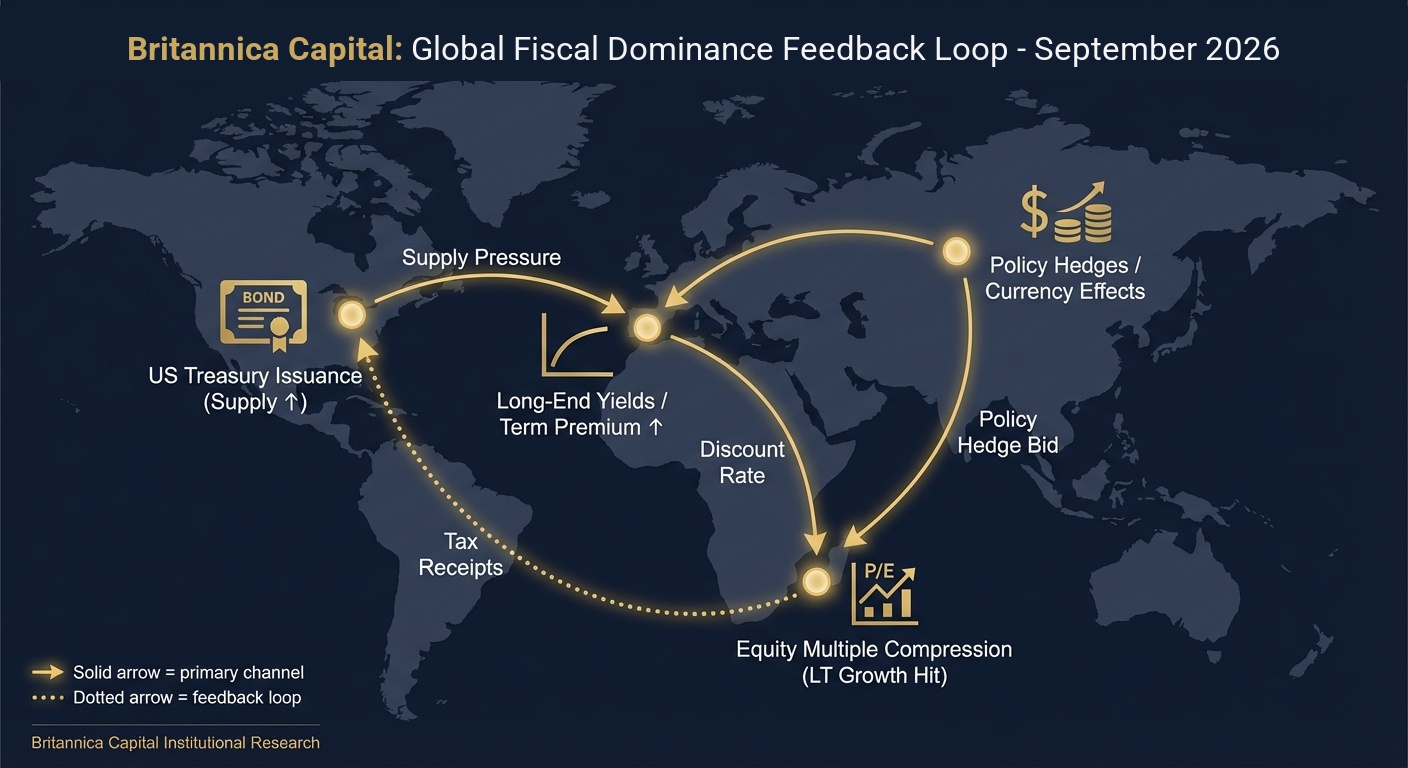
Global Fiscal Dominance Feedback Loop
Britannica Capital · Institutional Research
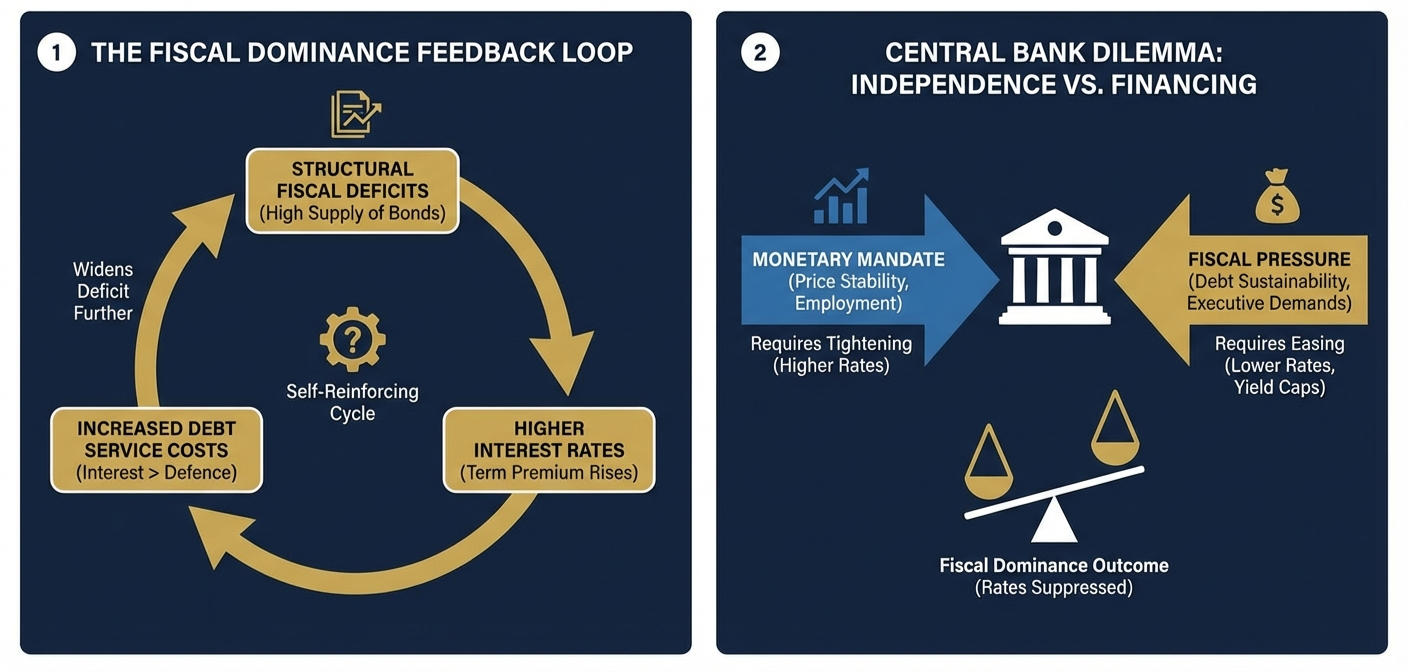
Fiscal Dominance Mechanisms
Britannica Capital · Institutional Research
Coming Soon
Video Content in Production
Video briefings and analyst commentary for this report are currently being produced. Check back for updates.
Executive Thesis
The global economy has entered a period where fiscal policy, rather than monetary policy, is the dominant force driving economic activity, asset prices, and inflation dynamics. In the United States, the federal deficit is running at more than 6% of GDP outside of a recession or wartime, a level without historical precedent; CBO's August 2026 estimate puts the fiscal 2026 shortfall at $2.1 trillion. Gross federal debt passed $40 trillion in August 2026, per Treasury's Debt to the Penny. Net interest on that debt now exceeds the defence budget. None of the three major rating agencies any longer rates US sovereign credit AAA.
This is the landscape of fiscal dominance: a regime in which government borrowing and spending are so large that they constrain, distort, or override the central bank's ability to maintain price stability. The Federal Reserve, under a new Chair since May 2026 and with inflation still above target, faces an increasingly difficult balancing act: holding rates high enough to anchor inflation expectations while knowing that elevated rates compound the very debt service costs that drive the fiscal imbalance.
For allocators and portfolio managers, the implications are profound. Duration risk is structurally higher than in previous cycles. Equity valuations are entangled with fiscal flows and tax receipt dynamics. The traditional assumption that monetary policy operates independently of fiscal constraints is being tested in real time, and the outcome of that test will define asset class returns for the balance of this decade.
$2.1T
FY2026 US Deficit (Est.)
CBO, August 2026 Estimate
$40T
Total US Public Debt
US Treasury, Debt to the Penny (September 1, 2026)
Multi-Trillion
OBBBA 10-Year Deficit Impact
CBO Estimates, as Reported
3.50–3.75%
Fed Funds Target Range
FOMC, July 29, 2026 (Held, 9–3)
01
Conceptual Framework
What Fiscal Dominance Actually Means
Fiscal dominance is not a binary state but a spectrum. At its core, it describes a condition where a government's fiscal position, its deficits and debt, puts such pressure on financing needs that monetary policy becomes subordinate to those needs. The central bank is pressured, implicitly or explicitly, to keep interest rates lower than macroeconomic conditions warrant, or to purchase government debt not to stabilise inflation and employment but to facilitate government financing.
The seminal framework comes from Sargent and Wallace's 1981 paper on "unpleasant monetarist arithmetic," which demonstrated that if fiscal deficits cannot be financed solely through bond sales to the market, the central bank is eventually forced to create money and tolerate additional inflation. The key insight is that persistent deficits, if left unaddressed, make inflation a fiscal phenomenon, not just a monetary one.
In the post-war period, the United States experienced fiscal dominance during World War II, when the Fed capped interest rates to facilitate war borrowing. The 1951 Treasury-Fed Accord restored central bank independence, creating the safeguards that are being tested again today. The difference now is that the fiscal trajectory is not driven by a temporary wartime emergency but by structural commitments, primarily entitlements (Social Security, Medicare, Medicaid) and rising interest costs, that have no natural expiry date.
The Fiscal Dominance Spectrum
Mild: Large deficits create political pressure on the central bank to ease, but independence is maintained. Bond markets provide discipline through higher term premiums.
Moderate: Debt service costs become so large that rate hikes are self-defeating, as higher rates increase deficits, requiring more issuance, which pushes rates higher still. The central bank faces a binding constraint.
Severe: The central bank explicitly or implicitly monetises government debt, abandoning its inflation mandate. Currency weakens materially. Inflation expectations de-anchor.
02
US Fiscal Landscape
The Deficit Machine: Scale, Structure, and Trajectory
The numbers themselves tell a compelling and sobering story. The fiscal 2025 deficit closed at $1.78 trillion, or 5.8% of GDP. Fiscal 2026 is running wider: the shortfall reached $1.8 trillion in the first ten months (October to July), and CBO's August 2026 estimate puts the full-year figure at $2.1 trillion, above 6% of GDP on CBO's August estimate and $200 billion above its February baseline, a level never before realised outside of wars and recessions. The primary deficit, which must be roughly in balance to stabilise the debt-to-GDP ratio, sits at approximately 3% of GDP. Gross public debt outstanding passed $40 trillion in August 2026, per Treasury's Debt to the Penny, having crossed $39 trillion only in March on the same measure.
The structural drivers are well understood but politically intractable. Mandatory spending programmes, primarily Social Security, Medicare, and Medicaid, account for the majority of federal outlays and are growing faster than revenue. Net interest on the debt exceeded $1 trillion in fiscal 2025 and is running 14% higher in fiscal 2026; through July it totalled $931 billion against $804 billion for national defence. This creates a self-reinforcing cycle: higher rates increase debt service costs, which widen the deficit, which requires more borrowing, which puts further upward pressure on rates.
The "One Big Beautiful Bill Act" (OBBBA), signed in July 2025, has added significant fiscal impulse. CBO estimates, as reported in the press, put the legislation's addition to federal deficits over the next decade in the trillions of dollars, through permanent extension of the 2017 tax cuts, expanded SALT deductions, and full expensing provisions. The revenue side has since weakened further: the Supreme Court's February 2026 ruling that IEEPA does not authorise tariffs halted collections and triggered refunds, and CBO now expects fiscal 2026 customs receipts to come in about $250 billion below its earlier projection. All of this is occurring during a period of relative economic stability, not in response to a crisis, making it a historical outlier comparable only to wartime or pandemic-era fiscal expansions.
Debt Dynamics: The Self-Reinforcing Cycle
With a substantial share of marketable federal debt maturing within twelve months, and the Treasury guiding in August 2026 that coupon auction sizes will hold for "at least the next several quarters", the marginal dollar of financing continues to fall on bills. The Treasury's interest rate sensitivity is therefore acute: even modest increases in refinancing rates translate into material increases in annual debt service. The feedback loop is clear: fiscal expansion drives rate pressure, rate pressure drives debt service costs, debt service costs drive further fiscal expansion.
Key Fiscal Metrics
Federal Deficit / GDP (FY2026, CBO Aug. Est.)
>6%
Primary Deficit / GDP
~3%
Net Interest vs Defence (Oct–Jul FY26)
$931B > $804B
Debt Maturing Within 12 Months
Substantial Share
Sovereign Credit Rating
AA+ / Aa1 (No AAA)
Exhibit 1
US Federal Deficit as % of GDP: 1970 to 2026 (Non-Recession Periods Highlighted)
Source: Congressional Budget Office (August 2026), US Treasury, FRED Illustrative chart built from public data. Not investment advice; not a description of any Britannica Capital position.
03
Central Bank Independence
The Federal Reserve Under Political Pressure
The independence of the Federal Reserve has been tested on multiple fronts over the past year. President Trump publicly demanded rate cuts through social media posts, as widely reported, stating in July 2025 that "our Fed Rate is AT LEAST 3 Points too high" and characterising the pace of easing as costing the country "$360 Billion a Point, PER YEAR, in refinancing costs." The pressure then moved from rhetoric to process: according to press reports, grand jury subpoenas were served on the Federal Reserve in January 2026 in connection with the headquarters renovation, were quashed by a federal judge in March, and the Justice Department dropped the matter in April 2026. While executive pressure on the Fed is not unprecedented, the intensity and form of the campaign has been unusual by post-Accord standards.
The succession itself has now resolved. Chair Powell's term ended in May 2026; Kevin Warsh was confirmed by the Senate on 13 May, by a 54–45 vote according to press reports that described it as the narrowest margin for a Fed Chair on record, and was sworn in on 22 May. Powell chose to remain on the Board as a Governor, with a term running to January 2028; press coverage characterised this as the first such decision by a former Chair in roughly three quarters of a century, and noted that it leaves the President without an additional Board appointment for now. Separately, the Supreme Court's ruling of 29 June 2026, reported as a 5–4 decision, held that a Governor is entitled to notice and an opportunity to respond before removal, leaving Governor Cook in place; press reports in August indicated the White House was weighing a renewed attempt. The Board's influence extends beyond direct votes; it shapes the appointment process for Reserve Bank Presidents, giving it eventual sway over the full Committee.
The early record of the new chairmanship has, if anything, cut against the "compliant successor" scenario. The FOMC held the target range at 3.50–3.75% on 29 July 2026 by a 9–3 vote, with all three dissenters preferring a quarter-point increase; and at Jackson Hole on 28 August Chair Warsh warned that inflation "is running above our 2 percent target" and that prices should be the Fed's "predominant focus", while declining to offer forward guidance. Headline CPI was 3.4% year-on-year in July 2026 (BLS). Market pricing at the end of August implied roughly even odds of a hike at the 15–16 September meeting, according to press reports. Former Treasury Secretary Janet Yellen, speaking at the American Economic Association meetings in January 2026, had framed the risk directly: fiscal dominance describes a situation where the government's fiscal position puts such pressure on financing needs that monetary policy becomes subordinate to those needs. The test now is whether an inflation-first stance can be sustained when tightening raises a $2 trillion deficit's financing cost in real time.
Near-Term Catalyst
The September 2026 Credibility Test
The 15–16 September FOMC meeting is the first real test of the new Chair's anti-inflation rhetoric under fiscal pressure. A hike into a $2 trillion deficit would demonstrate that the monetary mandate still binds; a hold, with three regional presidents already dissenting for tighter policy, could be read by the long end as evidence that debt affordability is beginning to weigh on the reaction function.
Institutional Risk
FOMC Composition Shift
Powell's decision to stay on the Board and the Supreme Court's June 2026 ruling on Governor removals have slowed, but not ended, the reshaping of the Board. The structure of the Committee, which includes both presidentially appointed governors and regional Reserve Bank presidents, provides some buffer against political influence, but that buffer is not unlimited, and press reports suggest the White House may revisit the Cook matter.
Market Signal
Term Premium Repricing
Ten- and thirty-year yields reached multi-decade highs in mid-August 2026, and the Treasury responded by at least doubling its long-end buybacks. A fiscal authority actively managing the shape of the curve is itself a symptom of the regime this report describes. The market is not pricing a full erosion of independence, but any credible threat to it will manifest first in the term premium, long before it appears in spot rates.
"If a central bank cannot raise rates because the Treasury will not allow it, then it ceases to be a central bank. It becomes a government agency."
OMFIF, September 2025
04
Market Implications
What Fiscal Dominance Means for Rates and Equities
The bond market is the primary transmission mechanism. In a fiscal dominance regime, the supply of government debt grows persistently faster than the market's natural demand for it. This puts structural upward pressure on yields, particularly at the long end, as investors require higher term premiums to absorb increasing issuance. The February edition of this report anticipated a drift toward 4.5% on the 10-year by year-end 2026; the market moved through that level by the summer. The 10-year closed at 4.79% and the 30-year at 5.27% on 1 September 2026, after both touched roughly 20-year highs in mid-August. The Treasury's response, announced on 19 August, was to at least double its buybacks of 10- to 30-year debt to $4 billion per operation from 9 September; the relief in yields lasted days. Foreign demand is softening at the margin: official data show foreign holdings of Treasuries fell to $9.3 trillion in June 2026, with China's holdings at their lowest since 2008. The framework suggests the long end remains exposed to further term premium expansion, with 5% on the 10-year no longer a tail scenario.
A structural shift is underway in how investors assess sovereign versus corporate credit. Corporate fiscal discipline has driven the fastest pace of credit upgrades in a decade, while G-7 governments show little restraint. High-quality corporate bonds are increasingly viewed by institutional investors as safer than sovereign debt on a relative basis, a development with significant implications for portfolio construction and asset allocation.
For equities, the relationship with fiscal policy is complex and non-linear. In the near term, fiscal expansion is supportive. The OBBBA provides direct tailwinds through full expensing, expanded deductions, and lower effective tax rates. The S&P 500 returned 17.9% including dividends in 2025 and has added roughly 12% in price terms in 2026 through early September, even as long-dated yields have risen. But the bond market's response, a "bear steepener" driven by deficit expectations and now visible in a 30-year yield above 5.2%, signals that the long-term cost is being priced in real time.
①
Persistent deficits increase Treasury issuance, creating structural supply pressure on the bond market
②
Term premium rises as investors demand higher compensation for duration risk and fiscal uncertainty
③
Higher long-term rates increase debt service costs, widening deficits further in a self-reinforcing cycle
④
Equity multiples compress as the discount rate rises, particularly for long-duration growth stocks
⑤
Fed faces impossible tradeoff between tightening to control inflation and easing to contain debt service costs
The Equity-Fiscal Feedback Loop
US federal tax receipts are highly correlated with equity market performance. Rising stock prices generate higher capital gains and dividend tax revenue. A market downturn reduces tax receipts, which widens the deficit, potentially requiring more issuance. Policymakers have a structural incentive to support equity prices, creating a fragile cycle where fiscal spending drives asset prices, rising asset prices sustain tax receipts, and those receipts are used to justify further spending.
Exhibit 2
10-Year Treasury Yield vs. Federal Debt Service Costs: 2010 to 2026
Source: FRED, US Treasury, Congressional Budget Office Illustrative chart built from public data. Not investment advice; not a description of any Britannica Capital position.
05
Global Dimension
Fiscal Dominance Is Not an American Problem Alone
The fiscal dominance dynamic is playing out across advanced economies simultaneously. France's public deficit came in at 5.1% of GDP in 2025, and the European Commission's Spring 2026 forecast sees it unchanged at 5.1% in 2026 before widening to 5.7% in 2027, with gross debt approaching 118% of GDP; persistent political instability since the 2024 snap elections has made meaningful consolidation exceptionally difficult. French 10-year government bond yields converged with Italy's around the turn of the year, a development that would have been considered extraordinary just two years ago.
Germany, long the anchor of European fiscal discipline, has shifted course. The announcement of a 500 billion euro infrastructure fund represents a historic departure from the fiscal conservatism that defined German economic policy for decades. While the economic rationale is sound, the signal to markets is clear: even the most disciplined advanced economies are moving toward fiscal expansion.
In Europe, the ECB's Executive Board is turning over: Vice-President de Guindos's term ended in May 2026, and Chief Economist Lane (May 2027), President Lagarde (October 2027) and Isabel Schnabel (December 2027) follow. This gives EU governments an unusual window to reshape the ECB's leadership, with implications for how the central bank manages the tension between accommodative policy for growth and discipline against fiscal free-riding.
The competitive dynamic matters for allocators. As the US lowers effective tax rates through OBBBA, European and Asian economies face pressure to match, creating a global fiscal expansion race where governments compete for capital through deficit-financed incentives. G-7 countries outside the US are now projecting increased fiscal spending, attempting to narrow the gap with the American playbook.
Global Fiscal Stress Points
United States (Deficit/GDP, FY2026, CBO Aug. Est.)
>6%
France (Deficit/GDP, 2026 Forecast)
~5.1%
Italy (Debt/GDP, 2026 Forecast)
~138%
Germany Infrastructure Fund
EUR 500B
ECB Leadership Turnover
2026-27
Dollar Implications
Despite fiscal concerns, the US dollar retains its reserve currency status and benefits from structural global demand for Treasuries. However, the simultaneous fiscal deterioration across advanced economies means that relative fiscal discipline, or the lack thereof, will increasingly drive currency dynamics. Gold's run to a record high in January 2026 (as widely reported), its subsequent correction, and its renewed bid in August, to around $4,435/oz at end of August 2026 (August 31), alongside the strongest second quarter of central bank purchases on record (289 tonnes, World Gold Council) reflect market hedging against fiscal uncertainty rather than traditional inflation fears.
06
Investment Implications
Positioning for a Fiscal Dominance Regime
Duration Risk
Active Duration Management
In a fiscal dominance regime, duration risk is structurally higher than in previous cycles. The yield curve faces persistent steepening pressure from deficit-driven supply at the long end. Passive buy-and-hold strategies in sovereign debt carry meaningful repricing risk. Active management with flexible duration mandates and tactical curve positioning is essential.
Credit Quality Inversion
Corporate Over Sovereign
The fastest pace of corporate credit upgrades in a decade, combined with deteriorating sovereign fiscal positions across G-7 economies, creates a structural case for high-quality corporate bonds over government debt on a risk-adjusted basis. This represents a fundamental shift in the traditional safe-haven hierarchy.
Real Assets
Hard Asset Allocation
In an environment of persistent fiscal deficits and gradual currency debasement, real assets (equities, real estate, gold, commodities) offer a pragmatic approach to preserving purchasing power. Gold's role as a "policy hedge" has been validated by its performance in 2025 and early 2026, and the framework favours a structural allocation in portfolios positioned for fiscal dominance.
Portfolio Construction Framework
Equities: Near-term, fiscal expansion supports earnings growth and risk appetite, particularly in domestic-focused sectors benefiting from OBBBA provisions (housing, financials, capital goods). However, long-duration growth stocks face compression risk if the long end of the curve continues to steepen. International diversification is warranted given the exceptional outperformance of MSCI World ex-USA in 2025 (roughly 32% in US dollar terms) and more moderate valuations outside the US.
Fixed Income: Reduce passive sovereign exposure in favour of flexible, actively managed strategies. Emphasise income generation and tactical duration. High-quality corporate credit increasingly competes with sovereign debt for safety. Monitor Treasury auction dynamics closely; the soft long-end sponsorship of summer 2026 and the Treasury's buyback response are precisely the pattern that precedes acute fiscal stress.
Alternatives: Gold and real assets deserve structural allocation as policy hedges. Central bank gold purchases of 289 tonnes in the second quarter of 2026, the strongest second quarter on record, signal institutional recognition of fiscal risk. Private credit offers attractive spreads but carries liquidity risk that is often underpriced.
◆
Treasury Auction Dynamics - Watch for declining bid-to-cover ratios or increasing tails, particularly in 10-year and 30-year maturities. These are early indicators of demand fatigue.
◆
Fed Credibility Under New Leadership - The single most important signal for monetary policy direction. With markets split on a September 2026 hike, the gap between the new Chair's inflation rhetoric and the Committee's actions is the metric to watch.
◆
Equity-Tax Receipt Correlation - If equity markets correct, monitor the resulting impact on tax revenues and deficit projections. The feedback loop works in both directions.
◆
Global Fiscal Competition - Track G-7 fiscal expansion plans and their impact on sovereign yield differentials, currency dynamics, and capital flow patterns.
07
Conclusion
The Decade Fiscal Policy Built
"Discretionary spending cuts alone cannot resolve the deficit problem. Without significant reforms to entitlement programmes and fundamental changes to the tax system, structural fiscal deficits will persist, dominating economic activity and serving as the primary driver of nominal growth and inflation."
Britannica Capital Research, September 2026
The fiscal dominance thesis is not a prediction of imminent crisis. It is a description of a structural regime that will define asset class returns for the foreseeable future. The deficit problem is unlikely to be resolved this decade, nor is it likely to culminate in a sudden collapse. Instead, it will run structurally hot, punctuated by occasional moments of market drama, while nominal figures steadily rise amid ongoing currency debasement.
The traditional policy framework, in which an independent central bank manages inflation through interest rate adjustments while fiscal policy operates within sustainable bounds, is being eroded from both sides. Deficits are too large. Political pressure on the Fed is too explicit. The maturity profile of the debt is too short. The entitlement commitments are too entrenched.
For portfolio managers and allocators, the appropriate response is not panic but disciplined recalibration. Duration positioning must account for structural term premium expansion. Equity exposure should favour sectors with pricing power and fiscal tailwinds while hedging against rate-driven multiple compression. Fixed income allocation should pivot toward corporate credit and flexible mandates. Real assets and gold deserve permanent portfolio weight as policy hedges, not tactical trades.
This is not the end of the road. The United States retains extraordinary economic strengths: deep capital markets, a reserve currency, high productivity, abundant natural resources, and household net worth well in excess of $170 trillion. But these strengths do not make fiscal imbalances costless. They simply raise the ceiling on how long imbalances can persist before they bind. The market is repricing that ceiling in real time, and portfolios should be positioned accordingly.
Final Assessment
Fiscal dominance is the defining macro theme of this cycle. It is not temporary, not cyclical, and not confined to the United States. The investment implications are structural: higher term premiums, greater bond volatility, a premium on corporate versus sovereign credit, and a persistent bid for real assets as policy hedges. Portfolios built for the previous regime of monetary dominance and fiscal restraint require fundamental reassessment.
Important Disclosures
This material has been prepared by Britannica Capital for informational purposes only and does not constitute investment advice or a recommendation, offer to sell, or solicitation of an offer to buy any security or interest in any investment vehicle. Any such offer will be made only by a confidential offering memorandum and only to qualified investors. Past performance is not necessarily indicative of, or a guarantee of, future results. All investments involve risk, including the possible loss of principal. Strategies discussed in this report may involve exposure to sovereign debt, corporate credit, equities, commodities, and alternative investments, all of which carry risks including interest rate sensitivity, credit default, market volatility, and liquidity constraints. Certain strategies may employ leverage, derivatives, concentrated exposures, and duration positioning that can magnify losses as well as gains. Any projections, targets, or forward-looking statements regarding interest rates, fiscal trajectories, deficit levels, or equity valuations are based on assumptions and are subject to change; actual results may differ materially, and no assurance is provided that any stated objectives will be achieved. References to indices, benchmark yields, or economic data are for illustrative comparison only; indices are unmanaged and not directly investable. Information herein, including fiscal data, debt statistics, and central bank policy assessments, is sourced from third parties believed to be reliable, including the Congressional Budget Office, US Treasury, Federal Reserve, and other institutional sources, but no representation or warranty is made as to its accuracy or completeness. Opinions reflect the judgment of Britannica Capital as of the date indicated and are subject to change without notice. Any hypothetical, scenario-based, or historical analysis has inherent limitations and does not reflect actual trading, fees, expenses, or market impacts.
Data Sources (As of September 1, 2026)
Congressional Budget Office, Monthly Budget Review (August 2026) and The Budget and Economic Outlook: 2026 to 2036 (February 2026); US Treasury, Monthly Treasury Statement (July 2026), Debt to the Penny (September 1, 2026), Quarterly Refunding Statement (August 5, 2026), buyback announcement (August 19, 2026) and Treasury International Capital data (June 2026, released August 2026); Federal Reserve, FOMC statement (July 29, 2026), Chair's Jackson Hole remarks (August 28, 2026) and Board press releases (May 2026); FRED (St. Louis Fed), Treasury constant-maturity yields and S&P 500 (September 1–2, 2026); Bureau of Labor Statistics, Consumer Price Index (July 2026); European Commission, Spring 2026 Economic Forecast (May 2026); World Gold Council, Gold Demand Trends Q2 2026 (July 2026); S&P Global, Fitch Ratings and Moody's sovereign rating actions and commentary (2023 to 2026, per press reports); Council on Foreign Relations, Committee for a Responsible Federal Budget, American Action Forum and Bipartisan Policy Center fiscal commentary (August 2026); Supreme Court of the United States opinions (February and June 2026).
About This Note
This report is educational market research prepared by Britannica Capital Research for
institutional readers. It is provided for informational purposes only and does not constitute
investment advice, a recommendation, an offer, or a solicitation to buy or sell any security.
Any positioning frameworks, allocation ranges, or scenario outputs shown are illustrative
analytical constructs; they are not a description of any Britannica Capital portfolio, position,
or holding, and they are not advice to any reader. Third-party data and research are attributed
to their sources and remain the property of those sources. Views are as of the date of
publication and subject to change without notice. Past performance is not indicative of future
results. Britannica Capital is a private investment management firm and is not a registered
investment adviser.