← Britannica Capital · Research & Intelligence
Semiconductor Chokepoints

Export Controls & the Equipment Bottleneck

Washington's expanding export controls target not just chips but the lithography equipment, EDA software, and advanced packaging tools that enable frontier semiconductor production. These chokepoints create cascading constraints across China's AI buildout ambitions.

Capex & AI Infrastructure

Divergent Capital Cycles

US hyperscalers are driving an unprecedented AI infrastructure capex cycle while China pursues parallel capacity through domestic alternatives and workaround architectures. The bifurcation is reshaping global capital allocation patterns and supply chain dependencies.

Political Economy

The Policy-Capital Feedback Loop

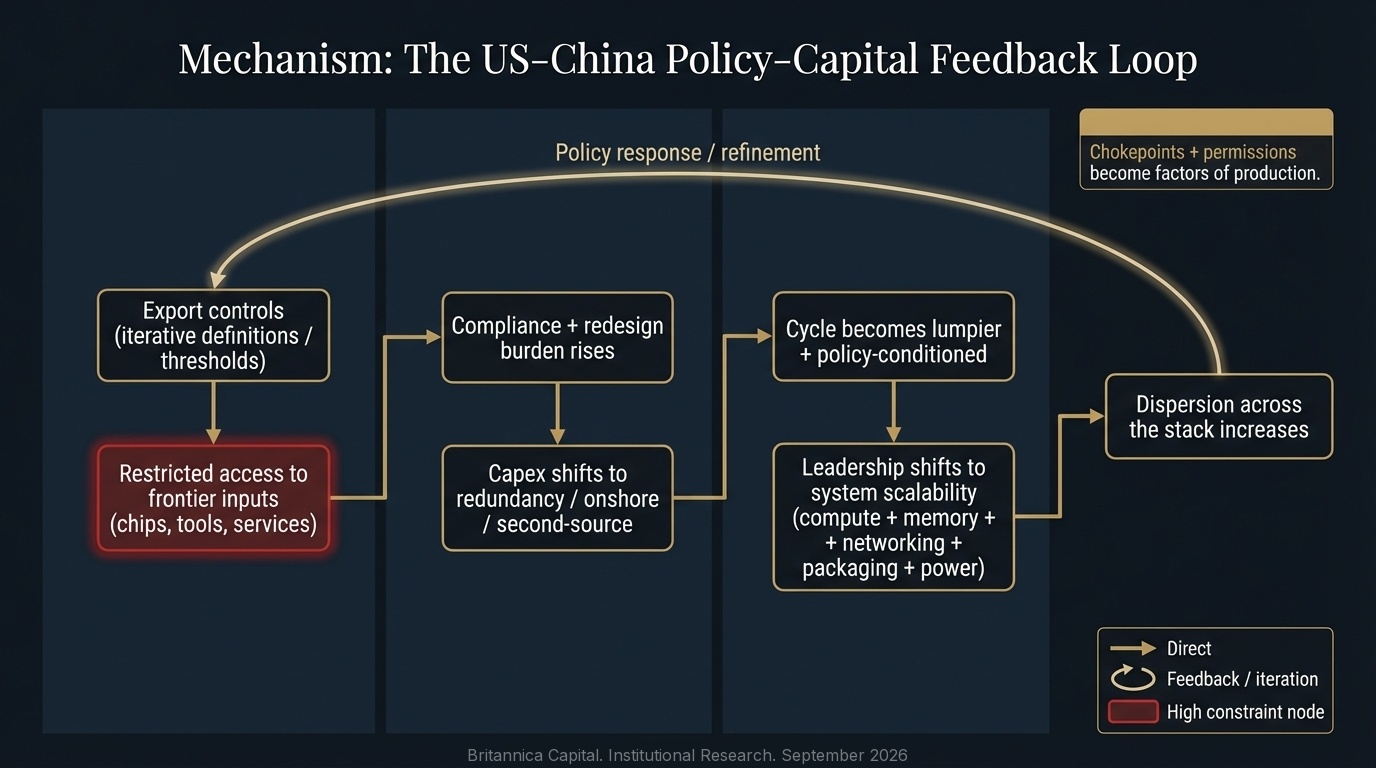
Technology restrictions, retaliatory industrial policy, and subsidy escalation form a self-reinforcing cycle. Each round of controls accelerates China's import substitution drive while narrowing the window for US firms to monetise their technology advantage.

Investment Implications

Positioning Across Scenarios

The framework maps three scenarios — managed competition, partial bifurcation, and full decoupling — with distinct implications for semiconductor equipment, foundry capacity, AI compute providers, and the broader technology supply chain.

Video Content
Video briefings and strategic competition analysis walkthroughs will be available here. Content is currently in production and will be published upon completion.
Executive Thesis

The strategic competition between Washington and Beijing is best understood not as a static confrontation but as a tightening feedback loop. Technology controls restrict—and continuously refine—access to advanced computing chips, supercomputing capabilities, and the specialized equipment that manufactures them.


These restrictions, in turn, reshape capital investment cycles, which now respond less to market signals than to policy imperatives and the demands of redundancy. Market leadership itself is migrating: what matters is no longer the excellence of a single component but the ability to deliver scalable, integrated systems—compute married to memory, networking, packaging, power management, and software.


In this environment, chokepoints and permissions matter as much as innovation—and, since the November 2025 trade truce, permissions are granted on both sides of the Pacific: Washington licenses what may leave, Beijing decides what may enter. The market implication is a regime in which policy evolves faster than supply chains can adapt, widening dispersion across the technology stack and fattening tail risks. Several truce-linked suspensions lapse in November 2026, which makes the next two quarters unusually calendar-driven.

$702B
Global Semi Sales H1 2026
WSTS · +102% y/y · $1.51T FY2026 forecast
Oct 2022
BIS Export Controls
Interim Final Rule · expanded Oct 2023
Jan 2026
H200 Case-by-Case Review
BIS Final Rule · 25% Sec. 232 tariff
Nov 2026
Truce Suspensions Lapse
Tariffs · Affiliates Rule · Rare Earths
01
Strategic Geography

Chokepoints, Clusters,
& Industrial Topology

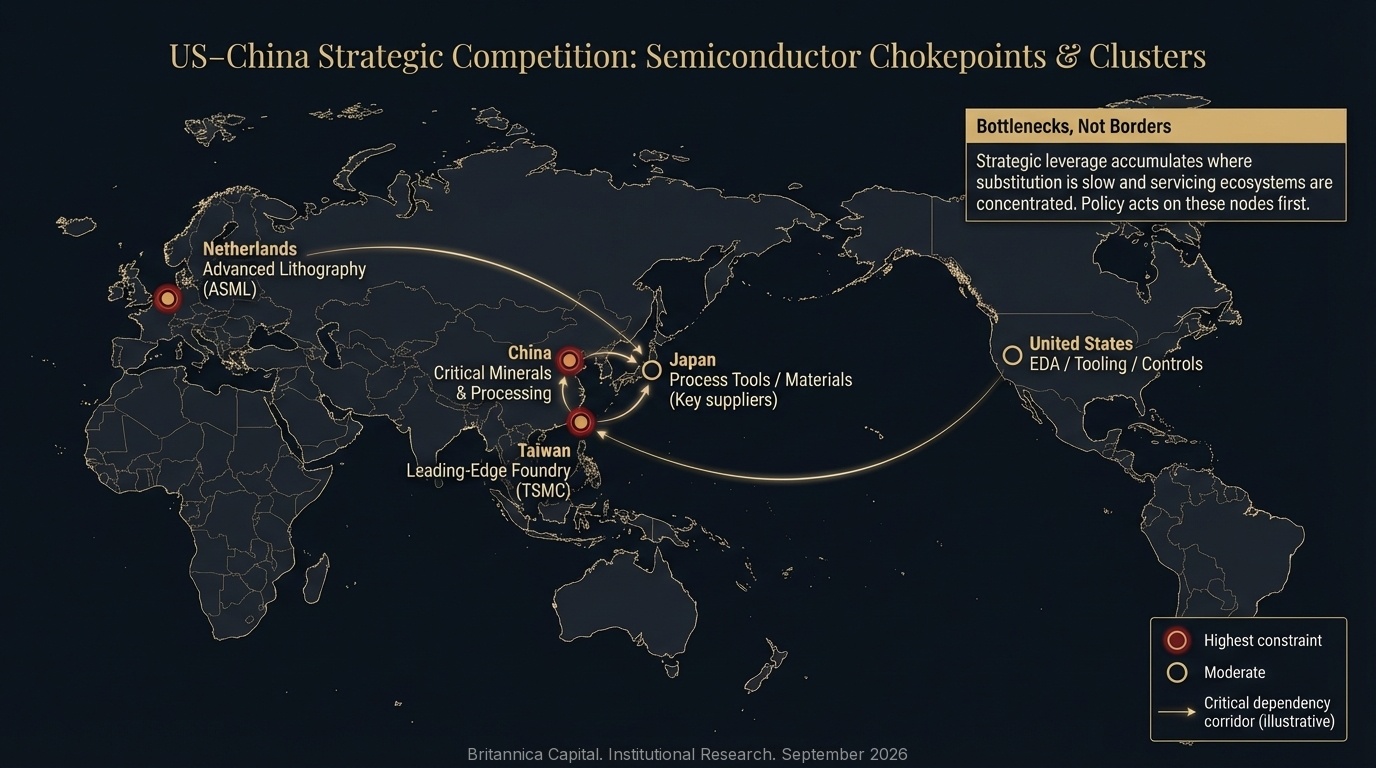
Geography is less about borders than bottlenecks. In this competition, strategic leverage accumulates where substitution is slowest: in advanced semiconductor manufacturing equipment, in the servicing ecosystems that keep those tools running, and increasingly in the upstream materials and processing capacity that feed them.

Allied chokepoints matter as much as American ones. Washington has pursued closer alignment with key equipment-producing allies, notably the Netherlands and Japan, which host critical advanced tooling capabilities. The Center for Strategic and International Studies has documented the reported January 2023 understanding and the subsequent Dutch and Japanese export-control measures that followed.

That alignment is now being tested from both directions. In June 2026 the Dutch government was reported to be lobbying Washington against further curbs on lithography sales to China as Congress debated the MATCH Act, which would codify equipment controls and give allies a fixed window to match them. In the same period, press reports citing Chinese customs data indicated minimal shipments of controlled rare earths such as yttrium and dysprosium to Japan. Chokepoints run both ways, and the servicing base for installed tools remains a distinct pressure point.

When leading-edge capabilities concentrate in a handful of locations, governments and corporations alike pay for resilience: second-source suppliers, diversified packaging, onshore capacity. The January 2026 US-Taiwan arrangement—investment commitments by Taiwanese chipmakers in exchange for tariff-free import allowances tied to new US capacity—is the clearest recent example. The economic cost is real. Redundancy capital becomes rational—even when inefficient. Resilience capital raises costs and duplicates capacity, even when near-term demand does not strictly require it.

Key Chokepoints
Advanced Lithography
Netherlands (ASML)
Manufacturing Equipment
US / Japan / NL
Leading-Edge Foundry
Taiwan (TSMC)
Critical Minerals
China Dominant
Rare-Earth Licensing
China · Apr-2025 regime in force
02
Political Economy

Export Controls as
Persistent Industrial Policy

Export controls are iterative, not episodic. The factual anchor is the October 7, 2022, interim final rule issued by the Bureau of Industry and Security, which imposed restrictive controls in two broad categories: advanced computing chips and certain supercomputing-related transactions, and certain semiconductor manufacturing items.

The bureau issued a major update on October 17, 2023, refining and expanding controls on advanced computing, supercomputing, and semiconductor manufacturing equipment. The correct framing is this: these policies aim to slow or constrain access to frontier inputs and reshape supply-chain behavior. They do not guarantee outcomes. Firms and states adapt.

The "controls versus capability" debate should be stated as debate. A more defensible formulation: controls can slow acquisition of frontier inputs and raise costs. But analysts also stress their limits—workarounds, redesign, substitution, and the reduced visibility that comes when transactions move into shadows.

The 2025–26 record illustrates the point. Controls were extended to high-bandwidth memory and additional tooling in December 2024 and to majority-owned affiliates of listed entities in September 2025—then partly unwound. The affiliates rule was suspended for one year on November 10, 2025 under the Busan trade understanding, and in January 2026 the bureau moved licence review for H200-class accelerators exported to China from a presumption of denial to case-by-case review, conditioned on US-based third-party testing and a 25% Section 232 tariff. Permissions have also become bilateral: Beijing gated the resulting imports through its own approvals, and reported deliveries through August 2026 remained a small fraction of licensed volumes. Meanwhile, the Commerce Department was reported in April 2026 to have halted equipment shipments to a second-tier Chinese foundry, and Congress is debating legislation that would narrow executive discretion over tool exports. The direction of travel is not linear; the iteration is.

Policy Mechanics

These controls create a dynamic compliance landscape where definitions, thresholds, and entity designations evolve continuously. Firms must maintain agility not merely in product design but in supply chain routing, customer screening, and regulatory interpretation.

Oct 2022: Initial controls on advanced chips & manufacturing equipment
Oct 2023: Major expansion & refinement of control scope
Dec 2024 – Sept 2025: HBM & tooling controls; entity-list affiliates rule (suspended Nov 2025 for one year)
Jan 2026: H200-class exports to China moved to case-by-case review with US testing & a 25% Section 232 tariff; Beijing gates imports
Ongoing: Allied coordination (NL, JP); MATCH Act pending in Congress; truce-linked suspensions lapse Nov 2026
03
Economic Dynamics

Capital Cycles in the
Age of Artificial Intelligence

Semiconductor capital investment is still cyclical—but now policy-conditioned. The semiconductor capital cycle remains cyclical. But the cycle is increasingly shaped by geopolitical and industrial-policy considerations: where capacity is built, what can be shipped, what must be duplicated. The result is a cycle that is lumpier and more sensitive to the decisions of a small number of firms.

Demand Concentration

AI Infrastructure Anchor

Data from the Semiconductor Industry Association and WSTS underscore how profoundly AI-linked demand is driving the sector. Global sales reached $791.7 billion in 2025 (+25.6%) and $702 billion in the first half of 2026 alone (+102% year on year), with second-quarter sales of roughly $403 billion up 35% on the first quarter. The WSTS spring 2026 forecast projects about $1.51 trillion for 2026 and $1.9 trillion in 2027, led by memory. A revenue base this dependent on one demand driver is itself a risk parameter.

Stack Implications

Beyond the Chip

Even if aggregate demand remains strong, it is increasingly stack-led—accelerators driving memory, networking, packaging, and power-thermal infrastructure. That increases dispersion within semiconductors and adjacent supply chains.

Counter-Leverage

Critical Minerals & Processing

China's April 2025 rare-earth licensing regime remains in force. The broader October 2025 controls, including a foreign-product rule, were suspended for one year to November 10, 2026 under the US-China truce, as was the December 2024 ban on gallium, germanium and antimony exports to the US (to November 27, 2026). Licensing has been uneven by destination, and shortages of yttrium and other heavy rare earths persisted into mid-2026. The market implication remains cost creep, licensing friction, and lead-time volatility—now with a dated cliff.

Macro Backdrop · As of September 1, 2026
China GDP, Q2 2026 (y/y) — slowest since late 2022; H1 2026 +4.7%
+4.3%
NBS Manufacturing PMI, August 2026 — second month below 50
49.8
CPI / PPI, July 2026 (y/y) — factory-gate deflation narrowing
+0.5% / −3.5%
70-City New-Home Prices, July 2026 (y/y)
−3.2%
USD/CNY, end-August 2026 — strongest yuan in over three years
≈6.72
China Holdings of US Treasuries, June 2026 (TIC)
$633B
US Goods Deficit with China, Jan–Jul 2026 (2025 full year: $202.7B)
$91.2B

Sources: National Bureau of Statistics of China; US Census Bureau; US Treasury TIC; PBoC fixings and market data as reported by Bloomberg and Reuters. Latest available readings at time of writing.

"The sober takeaway: even if aggregate demand remains strong, it is increasingly stack-led—accelerators driving memory, networking, packaging, and power-thermal infrastructure."
Britannica Capital Research
04
Market Leadership

What "Leadership" Means
Under Constraint

Leadership is migrating from component excellence to system scalability. In a constrained world, leadership increasingly means the ability to deliver an integrated, scalable stack: compute supply and disciplined product roadmaps; memory bandwidth availability; interconnect and networking throughput; packaging capacity and yields; power and thermal engineering; data-center readiness.

Crucially, this includes compliance agility—the ability to redesign product lines, reroute supply chains, and adjust market strategies on short notice. The H200 episode is instructive: US licences began to be granted in February 2026, yet Nvidia's quarterly filing for the period to April 26, 2026 reported no revenue under the programme and no data-centre Hopper shipments to China, with China-headquartered customers falling to roughly 6% of revenue from 22% a year earlier, as Beijing's own approvals gated imports. The sober point: the firms that prevail are not necessarily those with the single best chip. They are those that can scale the entire system under evolving rules—on both sides of the border.

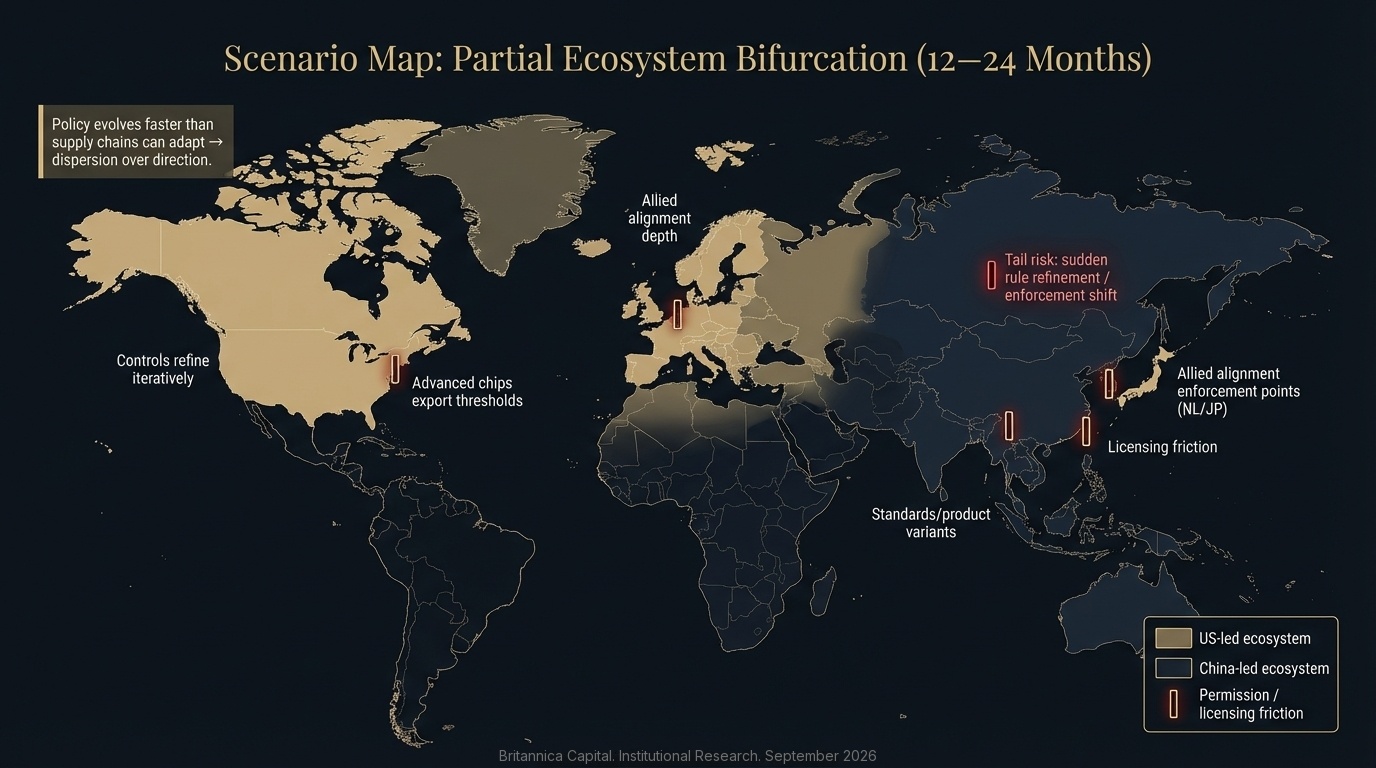
A reasonable, defensible framing is that policy trajectories and industrial incentives raise the probability of partial ecosystem bifurcation—standards, supply chains, and product variants diverging. This can be margin-positive at chokepoints, but costly where duplication becomes the norm.

System Stack Requirements
Compute Supply
Critical
Memory Bandwidth
Critical
Packaging & Interconnect
Critical
Power/Thermal Management
High
Compliance Agility
Critical
05
Scenario Map

What to Watch Over the
Next 12–24 Months

The Truce Calendar — Xi Jinping's scheduled Washington visit on September 24, 2026; the one-year truce, the affiliates-rule suspension and the rare-earth suspensions all lapse around November 10, 2026; the gallium-germanium-antimony suspension follows on November 27. Post-IEEPA replacement duties on Chinese goods stand at 12.5% (Section 301, effective July 24, 2026) on top of legacy Section 301 rates; a planned 7.5% "overcapacity" tariff would reach the 20% ceiling Beijing has said is consistent with the truce. Extension, lapse, or renegotiation is the single largest dated catalyst.
Further Control Refinement — Definitions, thresholds, licensing policy, entity designations—rather than a one-off escalation. Near-term markers: the "phase two" of the Section 232 semiconductor action, which reserved broader tariffs on chips and manufacturing equipment, and the MATCH Act's progress through the FY2026 defence authorisation. The system is iterative.
Allied Alignment Depth — The depth of allied alignment, especially around advanced tool categories and enforcement consistency, will determine control effectiveness. The Dutch push-back against statutory lithography curbs in mid-2026, and Japan's exposure to Chinese rare-earth licensing, are the live tests.
Revenue vs. Concentration Risk — AI demand drives exceptional top-line performance (H1 2026 sales roughly doubled year on year) but concentrates profit pools and supply constraints in memory, packaging and power. Watch for dispersion effects and for any moderation in hyperscaler capex plans.
Critical Minerals Friction — Watch for cost increases, licensing delays, and lead-time extensions in upstream supply chains as potential leverage points, especially in heavy rare earths where 2026 shortages have already been reported, and for whether suspended controls are extended or reinstated in November.
Ecosystem Bifurcation Signals — Standards divergence, separate supply chains, and incompatible product variants would mark a regime shift. Beijing's gating of licensed US accelerators and "buy-local" guidance, the scale-up of domestic accelerator output, and China's mid-2026 counter-measures (export-control listings of US firms, drone export restrictions) are the current markers.
06
Investment Implications

Pricing the
Regime

Policy Beta

Higher Policy Sensitivity

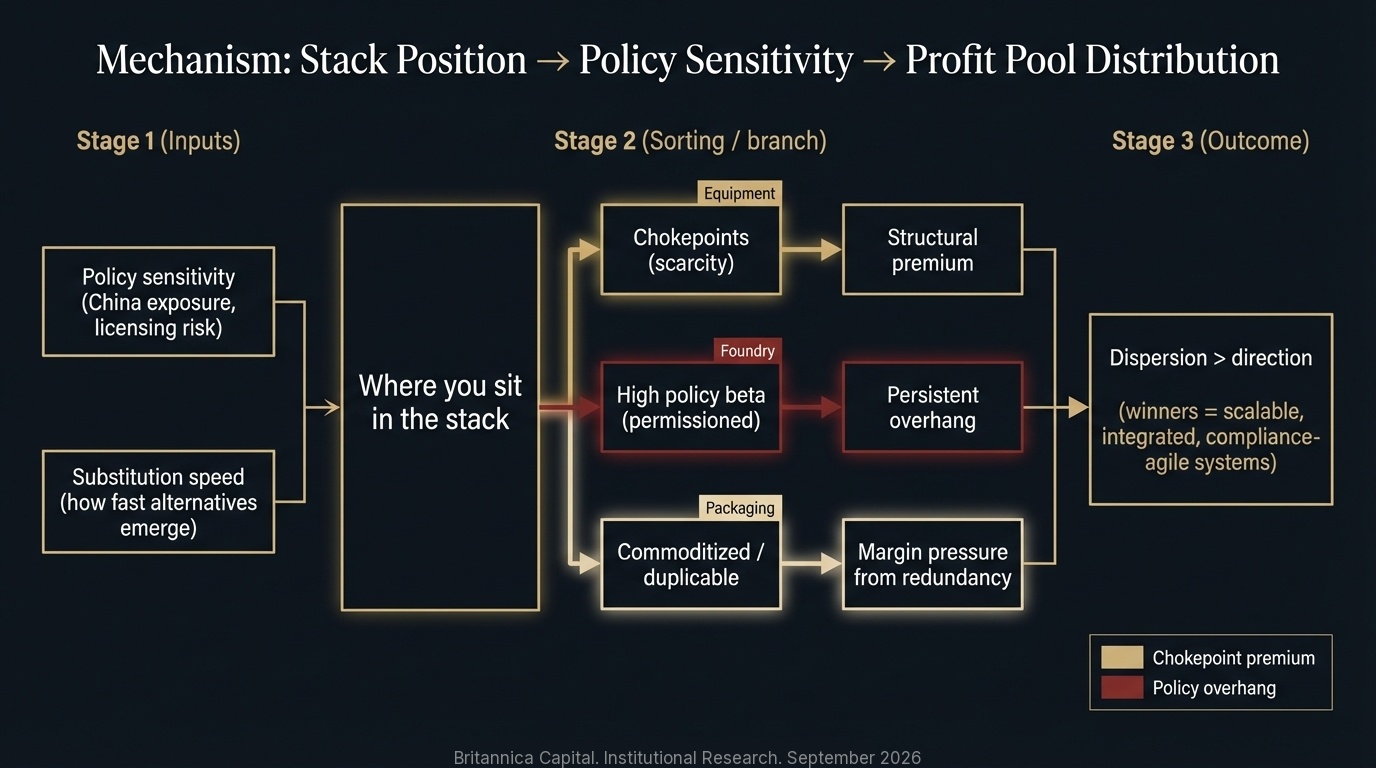
Firms with significant China exposure, dependencies on sensitive tooling, or high compliance burdens face persistent policy overhang. This introduces a new source of volatility orthogonal to traditional business cycle drivers—and the calendar concentrates it, with several truce-linked suspensions expiring within weeks of one another in November 2026.

Chokepoint Premium

Scarcity Value

Value accrues to scarce nodes where substitution is slow: advanced equipment categories, leading-edge manufacturing capacity, packaging, memory bandwidth, power and thermal management. These become structural moats.

Dispersion Trade

Stack Position Matters

In a bifurcating, constraint-shaped cycle, "the sector" matters less than where you sit in the stack and which jurisdictions you depend on. Dispersion over direction becomes the dominant theme.

Portfolio Construction

Traditional sector exposure frameworks underweight policy risk and chokepoint concentration. Effective portfolio construction requires explicit mapping of supply chain dependencies, jurisdiction exposure, and compliance burden. The firms that can navigate this regime are not necessarily the largest or most innovative—they are the most adaptable.

07
Conclusion

Pricing
the Regime

"The strategic competition between the United States and China is not merely a headline risk. It is a structural parameter shaping the geography of capital investment, access to technology, and the distribution of profit."
Britannica Capital Research — September 2026

The evidence-based description of the regime is this: controls are iterative, allied coordination is real, demand is strong but concentrated, and the system is increasingly priced around chokepoints and permissions.

Market leadership is migrating from component excellence to system scalability. Geography matters less for borders than for bottlenecks. Capital cycles respond less to market signals than to policy imperatives.

The investment implication is clear: in a world where policy evolves faster than supply chains can adapt, dispersion matters more than direction, and chokepoints command structural premiums. The firms that prevail will be those capable of delivering integrated, scalable systems under evolving constraints—not merely the best component, but the best system.

Final Assessment

This is not a temporary disruption returning to equilibrium. It is a regime change requiring continuous reassessment of supply chain exposure, compliance burden, and strategic positioning. The appropriate stance is one of continuous monitoring without false precision.

Sources & Data

Semiconductor Industry Association, annual 2025 sales release (Feb 2026) and Q2 2026 sales release (Aug 7, 2026); WSTS, Spring 2026 Forecast (May 2026) and H1 2026 market release (Aug 6, 2026); US Bureau of Industry and Security, revised license review policy for advanced semiconductors exported to China (Jan 13, 2026) and one-year suspension of the affiliates rule (Nov 10, 2025); White House, Section 232 semiconductor proclamation (Jan 14, 2026) and fact sheet on the US-China economic and trade arrangement (Nov 1, 2025); USTR, Section 301 forced-labour tariff action (effective Jul 24, 2026); Supreme Court IEEPA decision (Feb 20, 2026) via Congressional Research Service; US Census Bureau, trade in goods with China (data through Jul 2026); US Treasury, TIC major foreign holders (Jun 2026 data); National Bureau of Statistics of China, Q2 2026 GDP (Jul 17, 2026), July 2026 CPI/PPI (Aug 10, 2026), 70-city prices (Aug 17, 2026) and August 2026 PMI (Aug 31, 2026); CSIS, "Rare Earth Export Restrictions One Year Later" (Apr 27, 2026); Nvidia, Form 10-Q for the quarter ended Apr 26, 2026; American Enterprise Institute, China & Taiwan Update (Aug 21, 2026); Bloomberg, Reuters, CNBC, SCMP and China Briefing reporting through Aug 31, 2026. All figures are latest available at time of writing and subject to revision.

About This Note

This report is educational market research prepared by Britannica Capital Research for institutional readers. It is provided for informational purposes only and does not constitute investment advice, a recommendation, an offer, or a solicitation to buy or sell any security. Any positioning frameworks, allocation ranges, or scenario outputs shown are illustrative analytical constructs; they are not a description of any Britannica Capital portfolio, position, or holding, and they are not advice to any reader. Third-party data and research are attributed to their sources and remain the property of those sources. Views are as of the date of publication and subject to change without notice. Past performance is not indicative of future results. Britannica Capital is a private investment management firm and is not a registered investment adviser.