← Britannica Capital · Research & Intelligence
Oil & Infrastructure

Venezuela's Four Economies

Venezuela operates not as a single economy but as four parallel systems — the formal state, the dollarised urban economy, the subsistence periphery, and the illicit extraction network. Understanding this fragmentation is essential for pricing any reconstruction scenario and identifying where capital can realistically deploy.

Geopolitical Dynamics

US Oil as a Geopolitical Instrument

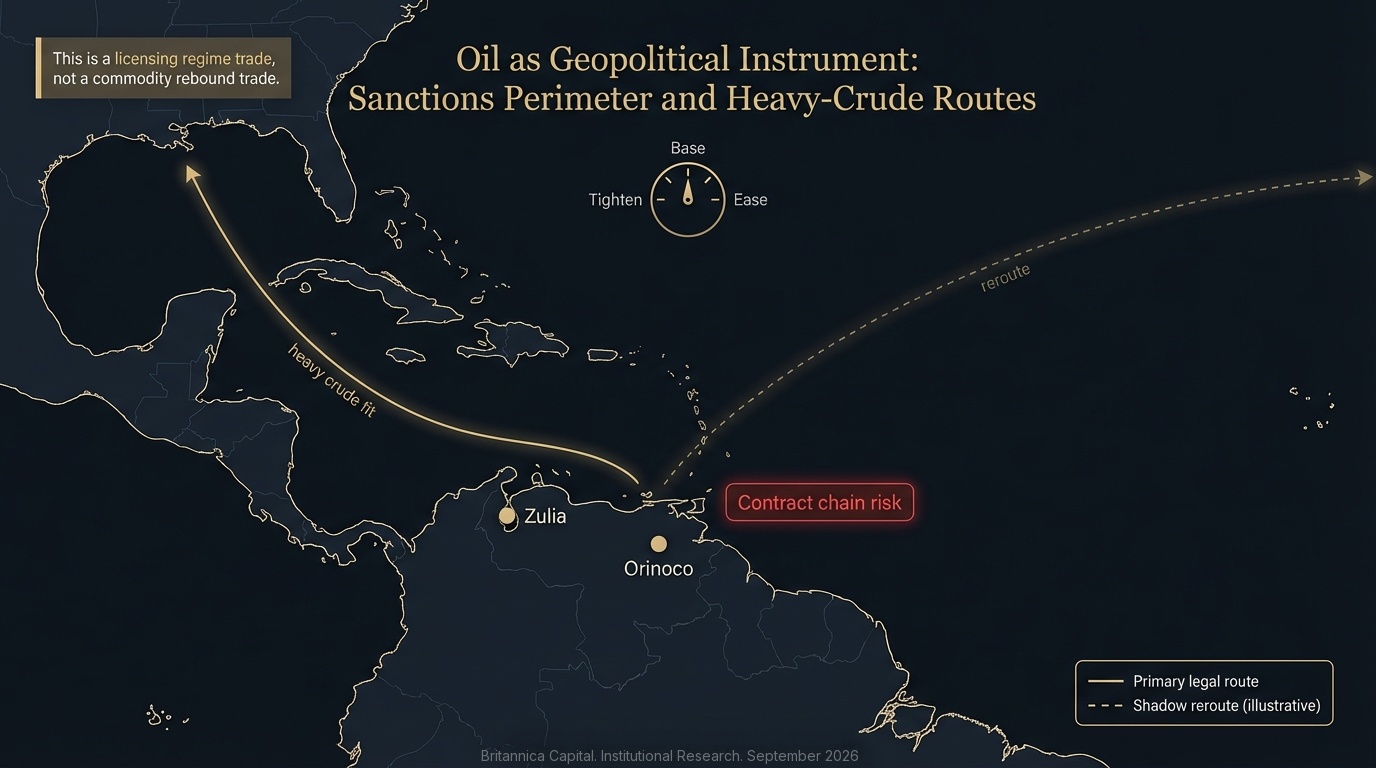
Washington's approach to Venezuela is driven by energy security calculus rather than democratic principles. The sanctions perimeter, OFAC licensing regime, and the handling of seized Venezuelan oil assets will define the investable corridor for international capital more than any domestic political outcome.

Political Economy

Why Stabilisation Can Still Be a Failure

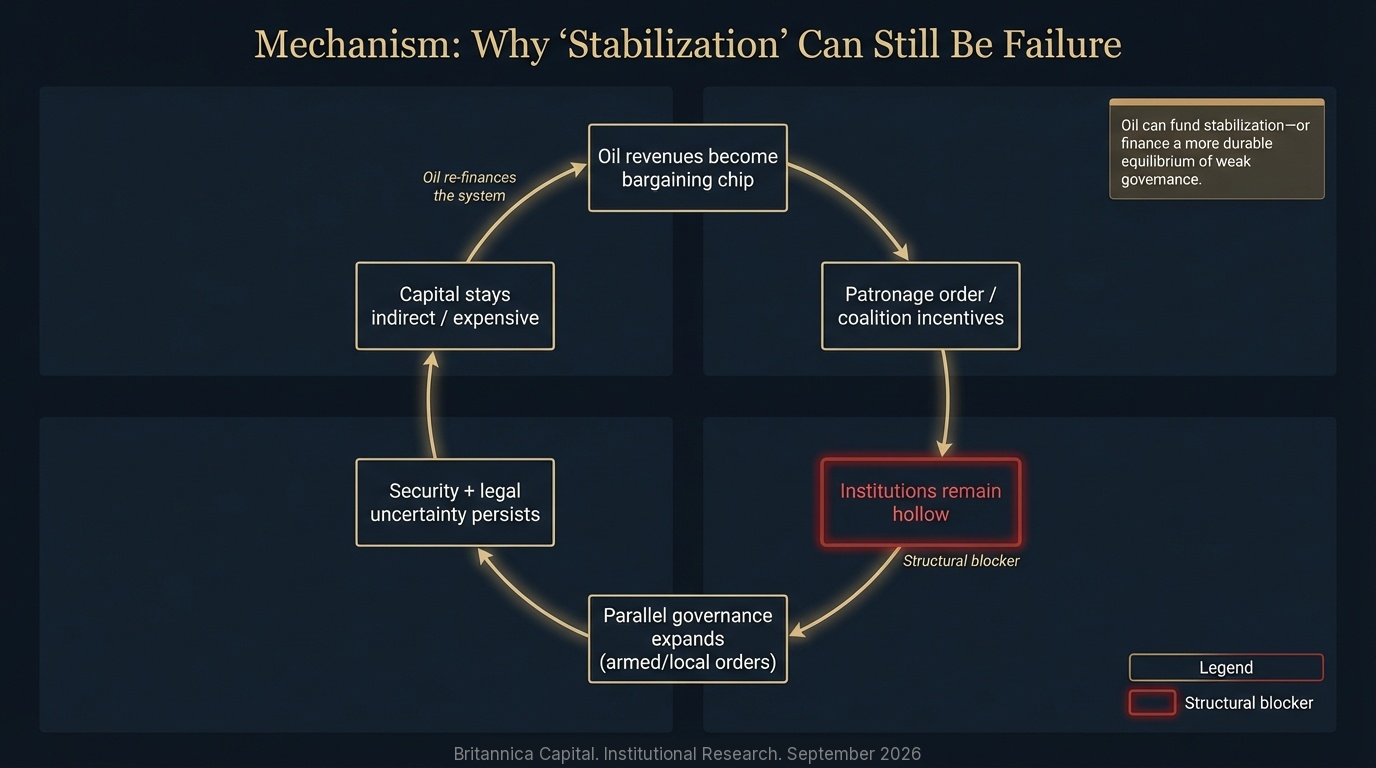
Post-Maduro stabilisation risks creating a new patronage order rather than genuine institutional reform. Oil revenues may fund elite consolidation rather than broad-based recovery, repeating the historical pattern where resource wealth entrenches political capture rather than enabling development.

Investment Framework

The Investability Gate

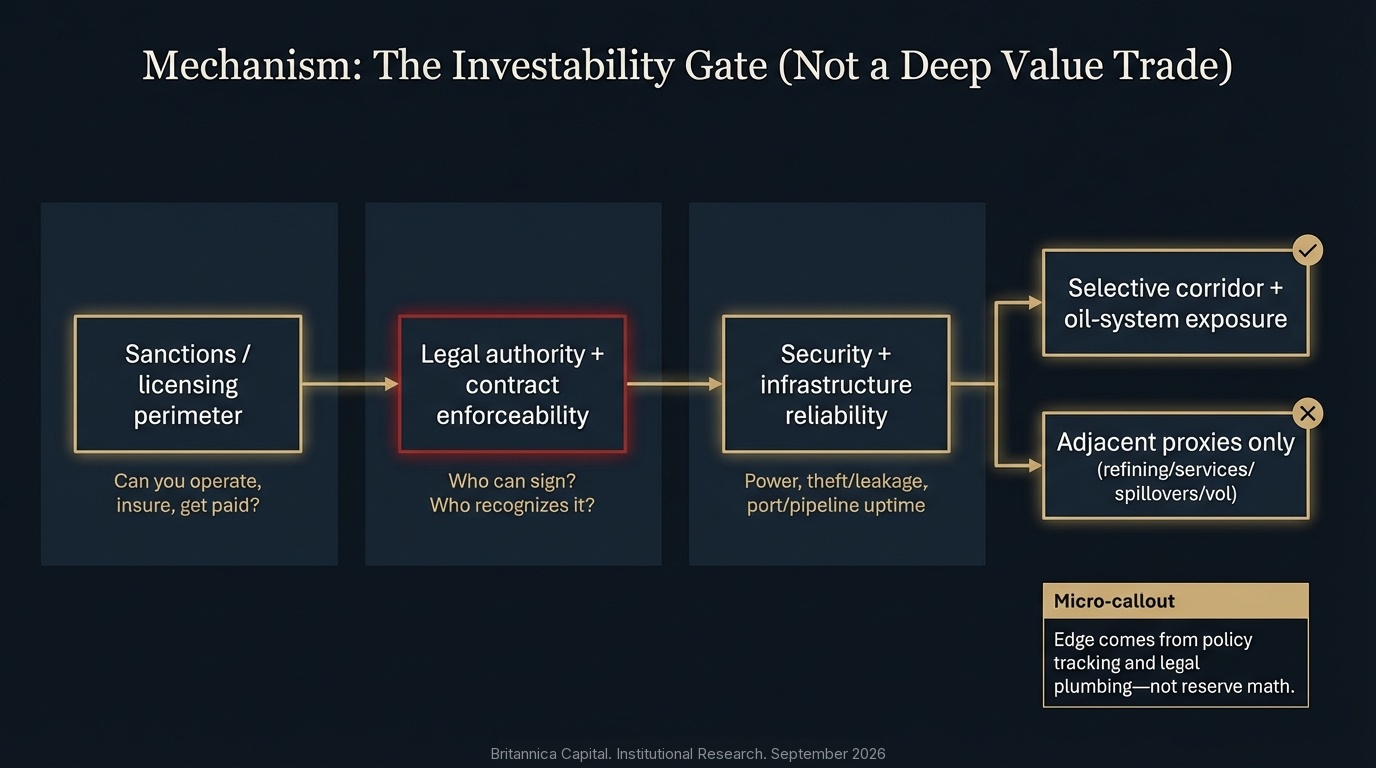
Capital deployment in Venezuela requires passing through a sequential gate: sanctions clarity first, then legal enforceability, then physical security, and finally commercial viability. Failure at any stage renders downstream analysis moot. As of September 2026 the first gate has opened materially through a broad set of OFAC general licences; the legal-enforceability and security gates remain incomplete.

Coming Soon
Video Content in Production
Video briefings and analyst commentary for this report are currently being produced. Check back for updates.
Executive Summary

The Oil-Led State Rebuild

Venezuela is not "about to recover." It is about to restructure—politically, economically, and geopolitically—under conditions that make clean recovery unlikely and contested stabilization the more realistic path.

This report was first written in the immediate wake of a major inflection point: the U.S. military operation of January 3, 2026 that ended with the arrest of President Nicolás Maduro, who—per the Congressional Research Service (CRS)—is now detained in New York awaiting trial on narco-terrorism charges. Eight months on (as of September 2026), CRS reports that Delcy Rodríguez remains acting president and has been formally recognized by Washington, and that U.S. policy runs on a three-phase plan (stabilization, economic recovery and reconciliation, political transition); OFAC has issued a broad set of general licences reopening the oil, gas, minerals and telecommunications sectors under strict conditions (per OFAC's published actions); an amnesty law has released more than 800 political prisoners, per CRS; and the June 24 earthquakes killed more than 6,000 people according to CRS and press reporting, leaving a reconstruction bill that UN agency estimates relayed by CRS put in the tens of billions of dollars. Government–opposition talks began in early August, per CRS. No election date has been set.

Core Thesis

Venezuela's next chapter is not a bounce-back story. It is an "oil-led state rebuild" attempt in a country where the oil complex has physically decayed, the institutional core has been hollowed out, and the geopolitical bargain around sanctions/recognition/security will determine the investable perimeter far more than commodity prices.

Key Findings
Reserves ≠ Prosperity
Venezuela holds the world's largest proven reserves (roughly 300 billion barrels, per OPEC's Annual Statistical Bulletin), but production collapsed from about 3.0 mbd in 1999 to about 0.5 mbd in 2020 (OPEC/EIA historical data), recovering only to about 1.0 mbd in 2025 and ~1.1 mbd by mid-2026 (OPEC secondary-source estimate for July 2026, as reported by CEIC and trade press). Binding constraints are infrastructure decay, skills drain, governance—not geology.
Oil as Operating System
In Venezuela, "the oil sector" is not one sector—it is the operating system for politics, currency regime, and distribution of social peace. Oil can fund stabilization or finance new patronage order.
Investability = Legal Clarity + Security
The investable Venezuela will be defined by sanctions perimeter, legal clarity, and security guarantees more than by commodity prices. If those conditions wobble, capital prices it as "no-go."

Three Questions for Capital Allocation

1) Can Venezuela rebuild a functioning oil state without recreating the resource curse?

Production path illustrates damage: even the partial recovery to ~1.1 mbd (July 2026, per OPEC secondary-source estimates as reported by trade press) sits on fragile foundations (degraded fields, under-maintained infrastructure, skills loss, theft/leakage, refinery system that couldn't reliably supply domestic fuel). Trade-press reporting of OPEC secondary-source estimates showed output dipping below 1 mbd early in 2026 before recovering—a reminder that the plateau is not yet reliable.

2) Who is Venezuela's external underwriter now—and what do they demand?

The January 2026 shift has hardened into U.S.-anchored energy rehabilitation: per CRS, Washington recognizes the acting government and Venezuelan crude is marketed through trading companies with proceeds held in U.S.-controlled accounts; per OFAC's licence terms and FAQs, authorized activity excludes Russian, Iranian, Chinese, Cuban and North Korean counterparties and routes disputes to U.S., U.K., French or Singaporean forums. Legitimacy remains contested, and the politics of who can sign deals and enforce them is still being written.

3) Where can capital actually flow given legal overhangs and volatility?

The base mistake investors make is treating Venezuela as a "deep value country trade." It is a jurisdictional risk trade with an oil optionality kicker. Instruments that matter: oilfield services/diluent supply chains/heavy-crude refining exposure; legal-claims and restructuring plays; regional spillovers (Colombia, Caribbean, Brazil).

Investment Takeaway

The right stance is not "buy Venezuela." It is "watch Venezuela as a catalyst," and position where the rulebook is enforceable: in refining/service supply chains, structured energy exposure, and regional spillovers—sizing for volatility rather than for smooth compounding.

Introduction

Why Venezuela Matters Now
(and Why It's Easy to Misread)

Venezuela is one of those countries that investors and policymakers repeatedly "rediscover," usually at moments when oil prices rise, sanctions shift, or a political rupture creates the illusion of a clean slate. January 2026 was precisely such a rediscovery moment; by September 2026 the rediscovery has hardened into a licensing regime, a reconstruction bill, and a political transition without a date.

Venezuela Is Three Problems, Not One

Geography Problem

The Orinoco Belt's heavy crude requires upgrading, diluents, and complex refining. Transport, pipelines, power reliability, and ports become binding constraints.

Institution Problem

The state's ability to tax, regulate, enforce contracts, and provide security is the core variable—not a given.

Security Problem

Where the state is weak, alternative armed governance fills the gap, shaping everything from migration to investment viability.

Why Markets Care Even When Venezuela Is "Uninvestable"

  • Heavy crude flows: U.S. Gulf Coast complex refining systems care about heavy barrels. Venezuela's recovery path reshapes differentials and feedstock strategies.
  • Sanctions as policy instrument: Live case study in whether sanctions produce regime change, state collapse, negotiated transition, or entrenched evasion networks.
  • Regional stability and migration: Close to 8 million have left since 2014 (UN/R4V estimates), with about 7 million in Latin America and the Caribbean per R4V's August 2026 update, stressing neighbors' labor markets, public services, and politics with second-order market effects.
  • Great-power competition: Laboratory for how external powers pursue influence through energy, finance, and security partnerships.
I
Core Analysis

Geography: The Resource Paradox

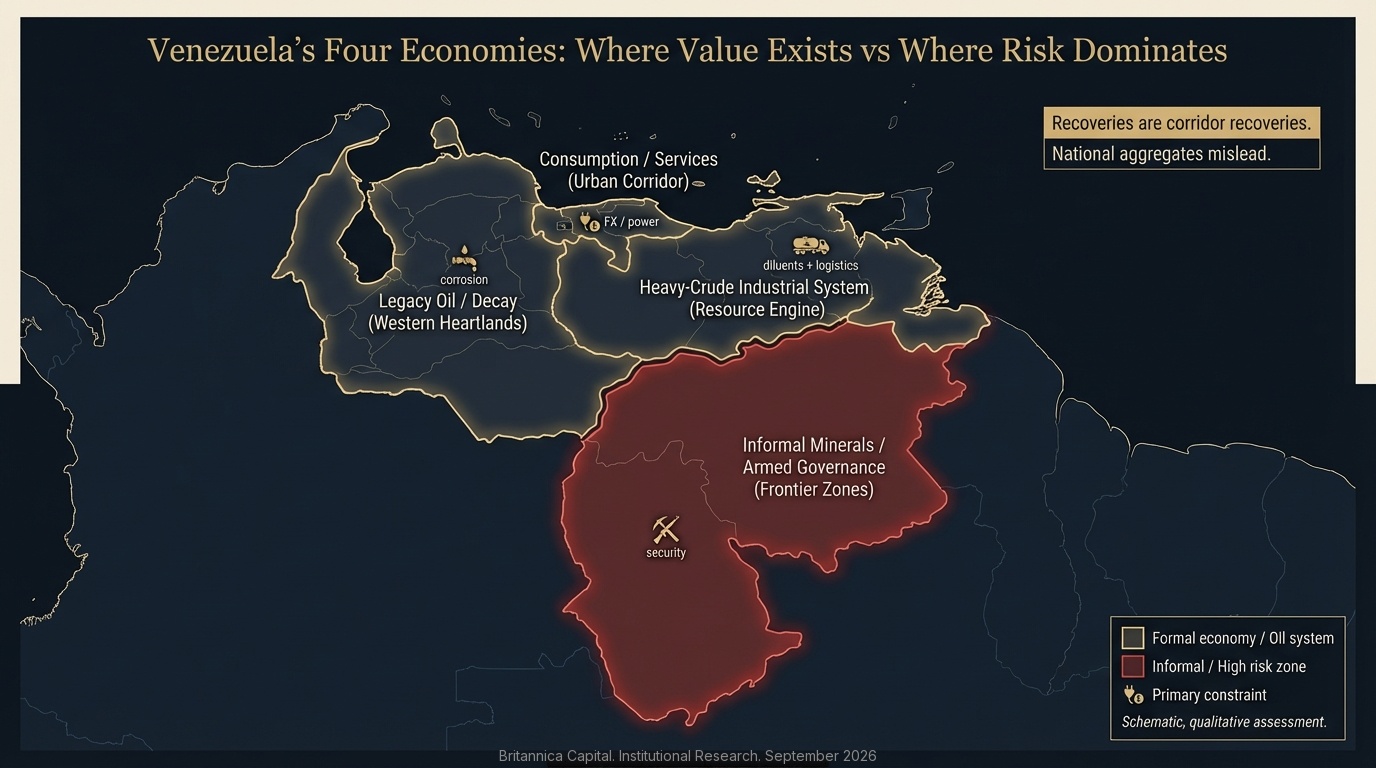
Venezuela is not one economy—it is four economies stacked on top of one another:

  • Caribbean urban corridor (Caracas–Valencia–Maracay): consumption, bureaucracy, finance, import dependence
  • Oil heartlands (Zulia/Maracaibo + Orinoco Belt): rent extraction, patronage, hard constraints of heavy crude
  • Llanos (plains): agriculture/livestock potential sacrificed to cheap imports and currency overvaluation
  • Guayana Shield / Amazon (Bolívar, Amazonas): minerals, informal economies, armed governance
Market Implication

Venezuela's recoveries are rarely broad-based. They are corridor recoveries (Caracas, parts of Zulia, selective industrial nodes). Investors who model Venezuela like a unified national economy will misread every cycle.

The Oil Geography: Two Petroleum Venezuelas

Western Oil (Zulia / Lake Maracaibo)

Historic oil core where decay is most visible: mature fields, aging pipelines, chronic leaks, infrastructure that punishes every operational mistake. Not a "restart story" but a salvage story.

The Orinoco Belt

Center of "largest reserves" narrative. Extra-heavy crude requires: diluents (naphtha/light crude); upgrading/blending capacity; functioning refineries and export logistics; stable partners willing to handle sanctions and payment risk.

Core Mechanism

Orinoco output is not merely "production." It is a supply chain—and Venezuela's binding constraint has often been the supply chain, not the reservoir.

When sanctions tighten, the system doesn't just lose markets; it can lose the chemical ingredients to move barrels.

Case Study I-A
The Orinoco Belt Isn't "Saudi Oil"—It's a Heavy-Crude Industrial System Venezuela Can't Currently Operate

Orinoco operating model historically depended on upgraders converting extra-heavy crude into synthetic crude. As system collapsed, Venezuela relied on improvised blending, degraded equipment, workaround logistics—exporting at discounts, leaning on opaque intermediaries.

Investor takeaway: "Venezuela has X barrels" is not investable. The investable statement is: "Venezuela can or cannot run an extra-heavy crude industrial system at scale." Evidence points to a country that may intermittently increase output but struggles to sustain high-reliability plateau without deep institutional repair.

Power: The Hidden Constraint

Oil is the headline; electricity is the bottleneck. Power system hits: industrial output, water supply, hospitals, digital commerce, mining. The binding constraint on "non-oil recovery" is often power stability, not capital availability.

Zone Export Engine Binding Constraint What to Watch
North urban corridorImports + servicesFX access, powerPayment rails, retail restocking
Zulia/MaracaiboLegacy oilCorrosion, maintenancePipeline integrity, blending
Orinoco BeltHeavy oilDiluents + logisticsLicensing, diluent flows
LlanosAgriculture potentialProperty rights, fuelDiesel supply, land tenure
Guayana/AmazonGold/coltan (informal)Security + illegalityEnforcement shifts
II
Core Analysis

Historical Arc: From Petrostates to Parallel States

Venezuela's transformation: from petrostate (state funded by rents) to parallel-state ecosystem (state plus competing rent collectors).

Periodization

  • Oil as modernization (mid-20th century): rents fund urbanization and middle class
  • Oil as political settlement (Puntofijo era): parties distribute rents to stabilize democracy
  • Oil as entitlement (1980s–1990s): society prices in permanent subsidy
  • Oil as revolution fuel (Chávez): rents finance redistribution + institutional overhaul
  • Oil as scarcity (Maduro): falling capacity + sanctions → coercion and informalization
  • Oil as bargaining chip (2024–2026): licenses, partial openings, geopolitical triangulation—culminating in the 2026 U.S.-anchored licensing regime (OFAC) and a reported early-2026 reform of the hydrocarbons law loosening PDVSA's monopoly over production and sales
Case Study II-A
PDVSA's Institutional Break Was the Real Regime Change

Most decisive break for investability was institutional: transformation of PDVSA from technocratic operator into political instrument. Once PDVSA became political vehicle, three things compounded:

  • Talent flight and deskilling: Engineers, geologists, operators left. Heavy-crude operations unforgiving to deskilling—becomes compounding production penalty.
  • Maintenance culture collapse: Populist governance prefers visible spending over invisible maintenance. Over years, turns facilities into failure cascades.
  • Cash extraction: PDVSA carrying state functions made commercial discipline impossible.

Investor takeaway: Relevant question isn't "Was Chávez good or bad?" It's: "When did Venezuela lose institutional capacity to convert oil into stable state revenue?" Once you date that break, you understand why "turnaround" narratives fail—they treat problem as cyclical when it's structural.

Maduro: Shift From Welfare State to Survival State

When revenues collapsed, state logic changed: from distributing enough to buy consent, to extracting enough to fund survival + coercion. Regime coalition stabilized by: licensing control, selective FX access, security force patronage, informal resource capture (gold), political control of courts.

III
Core Analysis

Economic Structure: The Country That Broke Its Price System

"Venezuela didn't just run out of money; it broke the system that tells money what it is worth."

Once the price system collapses—via controls, multiple exchange rates, monetary financing, arbitrary enforcement—production becomes irrational.

The Three Collapses

  • Output collapse (oil + non-oil)
  • Monetary collapse (currency credibility, inflation)
  • Institutional collapse (contracts, courts, enforcement predictability)

Recovery requires progress on all three. Venezuela has seen partial patches on monetary via de facto dollarization, but far less durable improvement on output and institutions. The monetary patch is again under strain: monthly inflation reportedly peaked above 30% in January 2026 before slowing to single digits by May (BCV data as reported by Venezuelanalysis and Trading Economics), yet 12-month inflation still stood at roughly 575% in July 2026 (BCV, as compiled by Trading Economics); the official rate had weakened to roughly 800 bolívars per dollar by early September 2026 (BCV official rate), and a wide gap between official and parallel rates—reported at around a third—persisted into mid-year (Venezuelanalysis, June 2026). Pre-earthquake forecasts pointed to growth of around 4% in 2026 (IMF April 2026 outlook, as relayed by CRS); local economists have since revised estimates downward, with quake-related losses that CRS reports in the range of $10–12 billion.

Case Study III-A
De Facto Dollarization—Stability for Markets, Brutality for the State

Venezuela's de facto dollarization is not clean policy choice; it's emergent survival mechanism. Stabilizes some transactions while hollowing out state capacity and entrenching inequality.

At street level, dollarization: (1) restores unit of account—businesses can plan week-to-week; (2) shifts economy from formal to informal—state loses ability to tax coherently; (3) creates dual reality—dollarized urban pockets vs bolívar-paid public sectors.

Capital allocation implication: Creates investable "islands" (retail, remittances-linked consumption) but raises sovereign risk. Government cannot tax dollar economy effectively—either tolerates informality (loses revenue) or cracks down (destroys fragile stability). Either path unstable.

Investor takeaway: Treat dollarization as regime, not recovery. Can persist for years but not same as macro normalization. Compromise equilibrium stabilizing trade/consumption for some while leaving state weaker—political risk structurally high.

VariableWhy It MattersProxy / Alternative Data
Real activityConsumption vs productionImports, VAT proxies, nightlights
InflationCurrency credibilityParallel FX, retailer price baskets
Oil monetizationState capacityExport volumes × realized price estimates
PovertyPolitical riskHousehold surveys, nutrition/health proxies
MigrationLabor + consumptionR4V/UNHCR host-country registrations
IV
Core Analysis

Political Economy: The Regime Is a Coalition, Not a Person

Operative unit is regime coalition: senior political leadership; military-commercial networks; security services; state enterprise elites; sanctioned intermediaries; local armed actors.

The Military as Economic Actor

In Venezuela, military is set of economic stakeholders. Negotiated transition more likely when: coalition members have credible guarantees; external patrons aligned; realistic fiscal plan can pay for defections. Without that, transitions blocked by fear and balance sheets.

Case Study IV-A
The Sanctions Paradox—Pressure That Can Entrench the System It Targets

Sanctions paradox: under certain conditions, sanctions degrade economy while strengthening political mechanics of regime survival. How:

  • Compress legal economy, expand discretionary economy: Power concentrates in whoever can allocate access to licenses, waivers, routes.
  • Shift incentives from investment to arbitrage: Rational actor shifts to short-term trading, smuggling, rent extraction.
  • Provide external enemy narrative: Rally population/apparatus around argument hardship is externally imposed.
  • Fracture opposition strategy: Opposition splits between maximalists and pragmatists on relief conditions.

Investor takeaway: Sanctions risk isn't binary. Structural feature shaping who makes money, how contracts work, whether reform coalition can finance itself legally. Any thesis assuming clean "sanctions lifted → recovery" is naïve. The 2026 licensing regime illustrates the point: per OFAC's licence text and FAQs, relief is now broad (oil, gas, diluents, minerals, telecommunications) but conditional—disputes must be heard in the U.S., U.K., France or Singapore; payments to blocked entities are routed through U.S.-held deposit funds; counterparties tied to Russia, Iran, China, Cuba or North Korea are excluded. The discretionary economy has not disappeared; part of its gatekeeping has moved to Washington.

Parallel Governance: Colectivos, Crime, Local Orders

In many zones, relevant political economy is local: armed groups control neighborhoods/mining routes; local authorities bargain with them; state alternates between toleration and selective crackdowns. Makes Venezuela less single sovereign state, more patchwork of negotiated micro-orders.

V
Core Analysis

Geopolitical Positioning: Sanctions, Patrons, and "Rent Diplomacy"

Venezuela is simultaneously: sanctions object for U.S.; debt-and-oil partner for China; symbolic ally for Russia/Iran; destabilizing variable for Colombia/Brazil/Caribbean.

Case Study V-A
January 2026 Shock—U.S.-Led Removal of Maduro and "Custodianship" Claim Over Venezuelan Oil

Early January 2026: U.S. forces captured Maduro in a military operation (per CRS). What makes this analytically important is precedent-setting framing around oil control—U.S. statements implying external control/"custodianship" over Venezuelan oil flows, plans to market inventory and direct revenue.

Three second-order questions for investors:

  • Legal status/recognition risk: If external control asserted over oil marketing, who recognizes it? What happens to contracts signed under previous authorities?
  • China/Russia reaction: If Washington asserts influence over production/exports, Beijing/Moscow face choice: condemnation, retaliation, or pragmatic adaptation.
  • Operational vs political control: Production system still depends on Venezuelan fields, workers, infrastructure. "Control" of revenue ≠ "control" of output.

Status, September 2026: The first question has been partly answered by Washington's own recognition of the acting government (formalized in the spring of 2026, with sanctions on Rodríguez subsequently lifted, per CRS) and by licence conditions that engineer enforceability offshore rather than relying on Venezuelan courts (OFAC). The oil-marketing arrangement has become routine: per CRS, crude is sold through trading companies with proceeds deposited in U.S.-controlled, externally audited accounts—cumulative proceeds that U.S. government statements relayed by CRS put in the low billions of dollars by spring, with larger figures cited later in the year not independently verified. Operational control remains Venezuelan: OPEC secondary-source estimates reported by CEIC and trade press put July 2026 output at roughly 1.1 mbd, and EIA monthly data show U.S. crude imports from Venezuela of roughly 630 kb/d in June 2026. The third question stands: revenue control has not translated into a reliable production plateau.

Investor takeaway: January 2026 shock doesn't create investable Venezuela—creates investable uncertainty regime. Eight months on it has produced a licensed corridor, not a rulebook: contract chains remain contested, export routing depends on licence text that has been amended repeatedly (most recently in OFAC actions of August 27 and September 2, 2026), and geopolitical spillovers persist.

Key Bilateral Relationships

U.S.: Sanctions as Dial

Most important "macro indicator" often not GDP/inflation—it's licensing regime direction and enforcement intensity. Determines: who can buy crude; what service companies can do legally; whether payments can clear; whether counterparties can insure shipments. Since January 2026 the dial has turned decisively toward ease: per OFAC's Venezuela programme page and recent actions, general licences now cover Venezuelan-origin oil (GL 46 series), U.S. diluent sales (GL 47), oilfield goods and services (GL 48), contingent contracts for new investment (GL 49), named international majors' operations including Chevron (GL 50 series), PDVSA transactions (GL 52), gold and minerals (GL 51/54/55), debt-restructuring advisory services to the government (GL 58, May 2026) and telecommunications (GL 61/62, August 2026). Diplomatic relations have been restored (per CRS) and commercial flights are reported to have resumed. The direction is clear; the durability across a U.S. political cycle is not.

China: From Big Bet to Managed Exposure

Tens of billions of dollars in loans-for-oil since 2007 (as tracked by the Inter-American Dialogue's China–Latin America Finance Database). Early posture looked like strategic bet; over time more like loss management: prioritize repayment/secured flows, limit new exposure, avoid getting trapped in internal politics. Behaved like disciplined creditor once project turned sour—patient but not naïve. The 2026 licences formalize the squeeze: per OFAC FAQ guidance, transactions involving Chinese-controlled counterparties fall outside U.S. authorizations, so Beijing's exposure is now managed for it as much as by it.

Regional: Migration as Labor Shock

Most concrete regional impact is migration—close to 8 million Venezuelans have left since 2014 (UN/R4V estimates), about 7 million of them in Latin America and the Caribbean per R4V's August 2026 update, against an in-country population of roughly 27 million (IMF estimate, as relayed by CRS). Changes: labor markets/informal sectors in hosts; political narratives; cross-border trade; remittances back (consumption stabilizer). The June 2026 earthquakes (Section VII) add a reported new displacement driver on top of the economic one.

Guyana–Esequibo: Tail Risk

Roughly 160,000 km² territory dispute revived by offshore oil discoveries in waters Guyana administers (Stabroek Block: more than 11 billion barrels of recoverable resources, per the operator's published estimates). Functions as nationalist rallying tool, bargaining chip, pressure mechanism. The ICJ's case record shows merits hearings scheduled for May 2026, with judgment pending (per the Court's docket); a ruling against Caracas would test whether the acting government, now dependent on U.S. goodwill, can absorb a nationalist setback. Even if conflict unlikely, elevated tension increases insurance/risk premia, diplomatic friction affecting sanctions/negotiations.

VI
Core Analysis

Culture & Society: Identity Under Pressure

Language

Spanish overwhelmingly dominant; some 40 indigenous languages survive among a small share of the population, including Wayuu, Warao and Pemón (census-based estimates).

Religion

Predominantly Catholic (with weakening institutional attachment) and a growing Protestant/Evangelical minority, Afro-Venezuelan traditions in coastal communities.

Social Values

Family centrality (though crisis fragmented families via emigration); "viveza criolla" (resourcefulness/rule-bending) reflects survival strategies in weak institutions.

Cultural Identity & Influences

Traditional fusion: Indigenous, European (Spanish), African influences. Joropo (national dance/music), arepa (staple food), pabellón criollo (national dish), Carnival celebrations, Diablos Danzantes (UNESCO heritage).

Western influence: Substantial 20th-century American cultural penetration via oil industry connections, media exports. Baseball became most popular sport. Bolivarian Revolution explicitly challenged this, promoting Latin American/Caribbean regional identification.

Crisis impact on cultural production: Ongoing crisis devastated cultural institutions: museums lack resources, orchestras/theater lost personnel to emigration, film production ceased, publishing contracted. Paradoxically, diaspora communities created new spaces for Venezuelan cultural expression abroad.

VII
Core Analysis

Conflict Dynamics: Internal Fractures and External Pressures

Internal Political Conflict

Fundamental struggle between the governing coalition and democratic opposition. Regime (Chávez legacy/Maduro-maintained) systematically dismantled democratic institutions; Maduro's removal changed the head, not the coalition, and Delcy Rodríguez's acting government retains the state apparatus. Opposition diverse/fractured, seeks democratic restoration, faces strategic disagreements, leader persecution, demoralization from repeated failures. As of September 2026, per CRS, both María Corina Machado and Edmundo González remain in exile and no election date has been set; the first formal government–opposition dialogue, held in early August 2026, produced reported agreement on judicial reform and recovery of frozen assets rather than a transition timetable (CRS, August 13, 2026).

State Repression & Human Rights

Systematic repression: arbitrary detention (leaders, journalists, activists); torture/mistreatment (UN-documented); extrajudicial killings (poor neighborhoods, crime control guise); manipulated legal persecution; surveillance/intimidation. UN concluded crimes against humanity committed. The January 2026 amnesty law has released more than 800 political prisoners, per CRS, but Foro Penal still counted roughly 380 detained as of early August 2026 (via CRS), and UN human rights monitors, as cited by CRS and Human Rights Watch, report that the structures of persecution have not been dismantled.

Humanitarian Crisis

Unprecedented in modern Western Hemisphere outside armed conflict: extreme poverty (exceeding 90% at the crisis peak, per the ENCOVI household survey; 86% multidimensional poverty in 2024, per Human Rights Watch); chronic malnutrition (child stunting/wasting); resurging infectious diseases (measles, diphtheria); maternal/infant mortality increases; medicine shortages (HIV/AIDS, cancer, diabetes); healthcare collapse; close to 8 million emigrants (UN/R4V estimates). The June 24, 2026 earthquakes—two major shocks in quick succession—killed more than 6,000 people by CRS and press accounts (reported tolls vary), displaced tens of thousands, and, as reported, damaged dozens of hospitals and the main international airport, layering a reconstruction need that UN agency estimates relayed by CRS put in the tens of billions of dollars onto an already stretched state.

Security Challenges

Reliable national homicide data has become scarce: the Observatorio Venezolano de Violencia has stopped publishing annual reports and InSight Crime's 2025 homicide round-up found no dependable 2025 figure. Violence remains elevated relative to regional peers and Caracas remains high-risk, reflecting firearms proliferation, gang warfare, weak/corrupt enforcement, drug trafficking, economic desperation. U.S. strikes on alleged trafficking vessels in the Caribbean, reported by CRS as ongoing since 2025, add an external security variable.
Conflict Resolution Prospects

Severe obstacles: regime survival imperatives (officials face sanctions/indictments/human rights accusations—transitioning risks prosecution, and Maduro's own pending trial in New York, per CRS, is the visible precedent); military loyalty (material incentives, ideological indoctrination, complicity in repression/corruption); an external underwriter that now prioritizes stabilization and oil flows over a transition calendar; opposition weakness (fragmentation, exile of its principal leaders, demoralization).

Most likely scenario: a managed transition without a date—incremental concessions (amnesty, dialogue, judicial reform) traded for licence relief and reconstruction support—rather than dramatic transformation, absent unexpected shocks or fundamental shifts.

Investment Framework

Market Implications: Investing Around Venezuela

Investable question is not "Will Venezuela recover?" It is: Which liquid instruments price Venezuela's pathways, and what is mispriced?

The Four Venezuela Trades

1) Oil Normalization Trade

Expression: Energy equities with Venezuela optionality; refiners; shipping; service firms (where legal).

Hidden assumption: Licensing eases and stays eased, monetizable production rises faster than infrastructure decay.

2) Sanctions-Volatility Trade

Expression: Volatility structures on oil; event-driven positioning around elections/negotiations; relative value between heavy crude grades.

Hidden assumption: Policy remains main driver (rather than abrupt security shock).

3) Neighbor Spillover Trade

Expression: Colombia/Peru/Chile consumption, labor-market effects, logistics, remittances, border trade.

Hidden assumption: Migration remains structural, host-country politics stay manageable.

4) Distressed Sovereign Trade

Expression: Venezuelan sovereign debt and PDVSA-related claims (highly specialized). Per OFAC, secondary-market dealing in the bonds has been licensed since October 2023 (GL 3I/9H); in May 2026 OFAC authorized U.S. advisers to work with the government on a potential restructuring (GL 58), and in August 2026 it issued GL 5Y on the PDVSA 2020 bond, with an effective date in mid-September 2026 per the licence text. No restructuring framework had been announced as of this writing.

Hidden assumption: Eventual settlement framework + legal clarity + political coalition that can sign—now with a reconstruction need in the tens of billions of dollars (UN agency estimates, via CRS) competing for the same oil revenue.

Why Direct Venezuela Exposure Is Usually a Trap

Direct FDI-style "rebuild the country" investment fails repeatedly because it assumes: enforceable contracts; stable property rights; predictable FX access; state that can guarantee basic services. In Venezuela, those are not baseline conditions—they are end-state outcomes.

Case Study VI-A
The Venezuela Trade Isn't a Country Trade—It's Litigation, Sanctions, and Contract Chain Trade

Venezuela rarely clean commodity rebound story—it's contract chain and legal-risk story. Even if barrels exist and political alignment shifts, investors face three durable frictions:

  • Sanctions architecture/licensing risk: Practical ability to operate, get paid, insure shipments, repatriate profits hinges on legal permissions that can change quickly.
  • Claims over assets/revenues: Dense thicket of creditor claims, arbitration, competing authorities. Creates "asset upside" in theory but means timelines long, outcomes court-mediated.
  • Reputational/compliance cost: Global institutions face compliance costs acting like tax on exposure. Pushes marginal investor base toward specialists (distressed debt, litigation finance, niche commodity trading).

What's actually tradable? Energy-market convexity (volatility positioning vs directional bets); LATAM spillovers (Colombia/Brazil/Guyana narratives vs Venezuela domestic); U.S. policy beta (sanctions-sensitive names/sectors); Distressed/legal specialists only.

Investor takeaway: Correct frame not "Venezuela is cheap." Frame is: "Venezuela high-optionality, high-friction arena where edge comes from legal interpretation, policy tracking, risk plumbing." Without structural advantage, rational strategy is adjacent liquid proxies vs direct exposure.

RiskProbability (12–24m)Market ImpactWhat Would Confirm It
Sanctions re-tightening / licence rollbackLow–MediumBearish monetizable oilEnforcement actions, licence non-renewal, U.S. political-cycle shift
Further sanctions easing (beyond 2026 licences)MediumBullish heavy crude flowsRemoval of counterparty/forum conditions, delisting of PDVSA
Grid shock / infrastructure failureMedium–HighAnti-growth, inflationaryPost-earthquake outages, fuel distribution breakdown, reconstruction stalls
Political crackdown cycleMediumRisk-off Venezuela/regionRenewed arrests, dialogue collapse, exile-return blocked
Negotiated political openingMediumBullish risk assetsElection date + guarantees + external alignment
Esequibo escalationLowRegional volatilityTroop movement, maritime incidents
Outlook

Scenarios to 2030

Base Case (45%): Managed Stagnation with Corridor Pockets

  • Partial dollarization persists
  • Oil remains below historical peaks with episodic gains/losses
  • Caracas consumption islands continue; interior remains fragile
  • Migration remains high; remittances stabilize consumption

Upside (25%): Partial Normalization

  • 2026 licensing regime proves durable across the U.S. political cycle; an election date is agreed
  • Monetizable oil rises; state revenue improves; reconstruction financing secured
  • Essential services stabilize in key corridors
  • Gradual re-entry of selective private capital

Downside (20%): Repression + Infrastructure Shock

  • Political hardening and fragmentation; dialogue collapses
  • Grid/fuel disruptions deepen; earthquake reconstruction stalls
  • Renewed outward migration wave
  • Oil monetization suffers even if output holds

Tail Risk (10%): Security Shock (Border/Esequibo or Internal)

  • Regional risk premia spike
  • Oil routing disrupted
  • Sanctions regime hardens in response
Final Investment Guidance

Venezuela's story in September 2026 is not clean "reopening" narrative markets prefer. It is transition in which oil becomes currency of state reconstruction—now literally, after the June earthquakes—and therefore central object of contestation. Even if production rises, hard work is not geological; it's institutional: rebuilding contract credibility, security, public services, fiscal system capable of capturing/sterilizing oil revenue rather than recycling into new patronage order.

Most likely outcome is constrained normalization: pockets of stability, selective investment, slow politically-negotiated rehabilitation—punctuated by policy reversals and legitimacy disputes. For capital allocators, right posture is disciplined: do not "buy Venezuela" as country trade. Treat Venezuela as catalyst that reshapes heavy-crude flows, sanctions policy, regional spillovers—express views where rules are enforceable.

Conclusion

The Stable Failure

"Venezuela may stabilize. It may even grow. But its defining risk will remain the same: whether the next oil-funded settlement builds a capable state—or merely finances a more durable version of the stable failure."
Britannica Capital Research, September 2026

The evidence is unambiguous. Venezuela's next chapter will be determined not by its reserves, but by its institutions. Eight months after the January 2026 inflection point—Maduro's removal and the assertion of U.S. influence over oil flows—the licensing question has been answered more fully than the institutional one. Recognition has arrived from Washington (per CRS); contract enforceability is being engineered by licence condition (offshore dispute forums, U.S.-held deposit funds) rather than by Venezuelan courts; security guarantees remain contested; and a reconstruction bill in the tens of billions of dollars (UN agency estimates, as relayed by CRS) now competes with creditors and patronage for the same oil revenue. The "stable failure" framing holds: the state is more stable than in January and no more capable.

For portfolio managers and allocators, Venezuela demands a shift in analytical frameworks. This is not a commodity play masked as a country play. It is a jurisdictional risk trade where the edge comes from legal interpretation, policy tracking, and understanding the difference between potential capacity and monetizable production.

The appropriate investment stance is one of active catalyst monitoring, explicit positioning in adjacent liquid markets, and disciplined avoidance of direct country exposure until institutional clarity emerges. Position where the rulebook is enforceable—refining infrastructure, service supply chains, regional spillovers. Size for volatility, not for compounding growth.

Final Assessment

The probability of Venezuela executing a clean, linear recovery to pre-crisis production levels within 36 months is low. The geopolitical and institutional drivers of dysfunction are structural, not cyclical. Portfolio positioning should reflect a regime where Venezuela's oil is a geopolitical instrument first and a commercial commodity second—meaning investability will oscillate with policy rather than converge to equilibrium.

Sources

Selected References

01
Congressional Research Service — "Venezuela's Post-Maduro Political Transition and U.S. Policy" (R49186), August 13, 2026; "Venezuela: Overview of U.S. Sanctions Policy" (IF10715), January 16, 2026.
02
U.S. Treasury, Office of Foreign Assets Control — Venezuela-related General Licences 46A–46D, 47–47B, 48–48C, 49, 50–50C, 51C/51D, 52B, 54B/54C, 55A, 58, 5Y, 61/61A, 62 and FAQs 1226–1233, 1244, 1247, 1266–1268; recent actions of January 29, February 3–18, May 5, August 3, August 21, August 27 and September 2, 2026.
03
OPEC — Monthly Oil Market Report, August 2026 (secondary-source estimate of Venezuelan crude production, July 2026), as reported by CEIC and trade press, August 28, 2026.
04
U.S. Energy Information Administration — U.S. Imports from Venezuela of Crude Oil, monthly series through June 2026.
05
Banco Central de Venezuela — National consumer price index, 12-month inflation through July 2026 (as compiled by Trading Economics); official exchange rate, September 3, 2026.
06
R4V (UNHCR/IOM Inter-Agency Coordination Platform) — Venezuelan refugees and migrants in Latin America and the Caribbean, August 2026 update.
07
International Court of Justice — Arbitral Award of 3 October 1899 (Guyana v. Venezuela), case record and hearing schedule, May 2026.
08
Human Rights Watch — World Report 2026, Venezuela chapter; Freedom House — Freedom in the World 2026, Venezuela; Foro Penal political-prisoner count, August 3, 2026 (via CRS).
09
Morgan Lewis — "Venezuela Oil Industry Sanctions Update: Analyzing OFAC General Licenses and New FAQs," February 2026; InSight Crime — 2025 Homicide Round-Up, March 2026; Venezuelanalysis — inflation and exchange-rate reporting, June 9, 2026.
Important Disclosures

This material has been prepared by Britannica Capital for informational purposes only and does not constitute investment advice or a recommendation, offer to sell, or solicitation of an offer to buy any security or interest in any investment vehicle. Any such offer will be made only by a confidential offering memorandum and only to qualified investors. Past performance is not necessarily indicative of, or a guarantee of, future results. All investments involve risk, including the possible loss of principal. Strategies discussed in this report may involve exposure to emerging markets, commodities, energy markets, and geopolitically sensitive regions, all of which carry elevated volatility, sovereign risk, and concentration risk. Venezuela-related investments face unique challenges including sanctions risk, contract enforceability uncertainty, expropriation risk, political instability, and the potential for total loss. Any projections, targets, or forward-looking statements regarding oil production, political transitions, or economic stabilization are based on assumptions and are subject to change; actual results may differ materially, and no assurance is provided that any stated objectives will be achieved. References to production figures, reserves estimates, and geopolitical developments are sourced from third parties believed to be reliable, but no representation or warranty is made as to their accuracy or completeness. Opinions reflect the judgment of Britannica Capital as of September 2026 and are subject to change without notice. Any hypothetical or scenario-based analysis has inherent limitations and does not reflect actual trading, fees, expenses, or market impacts. This report does not constitute legal, tax, or compliance advice; investors should consult qualified professionals before making investment decisions.

About This Note

This report is educational market research prepared by Britannica Capital Research for institutional readers. It is provided for informational purposes only and does not constitute investment advice, a recommendation, an offer, or a solicitation to buy or sell any security. Any positioning frameworks, allocation ranges, or scenario outputs shown are illustrative analytical constructs; they are not a description of any Britannica Capital portfolio, position, or holding, and they are not advice to any reader. Third-party data and research are attributed to their sources and remain the property of those sources. Views are as of the date of publication and subject to change without notice. Past performance is not indicative of future results. Britannica Capital is a private investment management firm and is not a registered investment adviser.